
How do you design essential oil labels that do not peel or smudge?
Short answer: To design essential oil labels that stay sharp and flat, divide your wrap into three vertical zones, set 5-point Latin binomials and cautions in 100% black vector ink, add matte or gloss lamination, and leave a ⅛ inch seam gap. Order custom essential oil labels from 500 pieces.
On this page
- How do you lay out a 3-panel essential oil wrap on a 15 ml or 10 ml bottle
- What botanical and safety details do customers expect on an essential oil label
- How do you design essential oil labels that never peel, smudge or stain
- How do you organize 15 to 40 scents on one shared dieline to lower cost
- Common mistakes
- FAQs
Request a custom quoteFree dieline & 3D mockup
Designing an essential oil bottle label requires fitting botanical provenance, dilution instructions, topical safety warnings, and a GC/MS batch lot number onto a tiny 2.5 × 1.0 inch (5 ml) or 3.375 × 1.625 inch (15 ml) canvas without cluttering the front display panel. The industry-standard solution is a 3-panel wrap layout: the center Principal Display Panel shows your brand logo, common scent name, italicized Latin binomial, and dual net contents (ml and fl oz); the left wing lists plant part, extraction method, country of origin, and batch lot code; and the right wing carries dilution ratios, phototoxicity cautions, and distributor details. Setting all 5-point to 6-point copy in 100% K-only vector black keeps tiny serifs crisp on press, while pairing a protective matte or gloss finish with a ⅛ inch back seam gap prevents oil smudges and edge lifting.
How do you lay out a 3-panel essential oil wrap on a 15 ml or 10 ml bottle?
When a 3.375 × 1.625 inch wrap is applied to a 1.125 inch diameter 15 ml euro-dropper bottle, a customer holding the bottle upright can only see the front 1.15 to 1.25 inches of width without rotating the vial in their fingers. If your headline stretches 2.25 inches across the artboard, the first and last letters disappear around the curved glass sides. Dividing your dieline into three vertical panels solves this curve problem and gives every piece of aromatherapy data a predictable home across all 20 or 30 scents in your catalog. When ordering custom printed essential oil labels, ask our design team to place vertical fold guides on your digital proof and 3D vial mockup so you can preview how the front face looks straight-on.
| Wrap zone (on a 3.375 × 1.625 in 15 ml label) | Panel width | What to include in this zone | Typography & print rules |
|---|---|---|---|
| Center panel (Principal Display Panel) | 1.25 in wide (center) | Brand logo, common oil name (Lavender), italicized Latin binomial (*Lavandula angustifolia*), purity statement, net contents (15 ml / 0.5 fl oz) | High contrast; keep oil name centered within 1.10 in so it never wraps around the glass curve |
| Left side panel (Botanical & batch specs) | 1.00 in wide (left) | Plant part (flowering tops), extraction method (steam distilled), country of origin, aroma profile, open-dated GC/MS batch lot box | 5.5 to 6.5 pt clean sans-serif; leave an unvarnished or light box if stamping lot codes after filling |
| Right side panel (Dilution & cautions) | 1.00 in wide (right) | Topical dilution ratio (e.g., 2% in carrier oil), external-use and phototoxicity warnings, distributor city/state, website or QR code | 5.0 to 6.0 pt 100% K-only black vector text; 0.5 × 0.5 in quiet zone if printing a QR code |
| Outer bleed & safe margins | 0.0625 in (1/16 in) all around | Background Pantone band bleeds 1/16 in past cut line; keep all text at least 1/16 in inside the die-cut edge | Prevents white slivers at the cut edge and protects tiny text from knife drift |
What botanical and safety details do customers expect on an essential oil label?
Practicing aromatherapists, estheticians, and wholesale spa buyers judge the credibility of an essential oil brand in five seconds by reading its side panel. Whereas a general fragrance bottle only lists a scent name, a true botanical essential oil or synergy blend should identify the exact chemotype and plant species so buyers never confuse *Lavandula angustifolia* (true lavender) with *Lavandula intermedia* (lavandin) or *Eucalyptus globulus* with *Eucalyptus radiata*. If your bottle is tiny, such as a 5 ml euro-dropper (2.5 × 1.0 in) or a 1 to 2 ml sample dram, you do not have to cram a full retail UPC barcode and a paragraph of diffuser recipes onto the glass wrap. Keep the core identity, Latin binomial, net volume, lot code, and caution line on the vial wrap, and pack the bottle inside a matching custom essential oil box or custom dropper bottle box that carries the full barcode and usage guide.
- Common name and Latin binomial: Print the common name in bold and the scientific species name in italics directly underneath.
- Plant part and extraction method: Specify whether the oil was steam distilled from needles, cold pressed from peel, or CO2 extracted from resin.
- Dual net quantity declaration: Place both metric and US fluid ounces (such as 15 ml / 0.5 fl oz or 10 ml / 0.33 fl oz) near the bottom of the front panel.
- Dilution and phototoxicity warnings: Note 'Keep out of reach of children,' 'Dilute before topical use,' and sunlight warnings on cold-pressed citrus oils.
- GC/MS lot code zone: Reserve a high-contrast white or light rectangle where your batch number links the bottle to its gas chromatography purity report.
How do you design essential oil labels that never peel, smudge or stain?
Two physical forces attack an essential oil label after filling: outward spring tension from the narrow 0.75 to 1.125 inch glass cylinder, and terpene oil drips running down the orifice reducer. You can eliminate both failures at the artwork and prepress stage before a single roll goes on press. First, size your artboard using our essential oil bottle label size chart so there is always a ⅛ inch (0.125 in) vertical gap between the meeting ends of the wrap. When designers create a wrap that overlaps onto itself on a 10 ml rollerball or 15 ml bottle, the trailing edge sits on top of slick lamination instead of high-energy bare glass, causing the seam to pop open. Rounding your four label corners to a 1/16 inch (0.0625 in) radius also prevents sharp 90-degree corners from catching on wooden drawer slots or folding carton flaps. Second, protect your printed ink with a matte or gloss laminated finish, or choose custom clear labels or custom foil labels as detailed in our guide to oil-resistant film vs paper labels for essential oil bottles. Finally, build an isopropyl alcohol wipe step into your filling SOP so your team removes invisible oil mist from the glass exterior before rolling on the label.
Know your size? Compare pricing across up to 3 quantities.
Request a Quote →How do you organize 15 to 40 scents on one shared dieline to lower cost?
Most essential oil brands launch with at least 12 single notes (Lavender, Peppermint, Eucalyptus, Tea Tree, Lemon, Sweet Orange, Frankincense, Rosemary, Cedarwood, Lemongrass, Ylang Ylang, Patchouli) plus 4 to 8 signature blends (Sleep, Breathe, Focus, Immunity). Creating a separate layout from scratch for every scent slows down proofing and drives up design hours. Instead, lock one master 3.375 × 1.625 inch template for all 15 ml bottles and one 2.125 × 1.75 inch template for all 10 ml rollerballs, then color-code your catalog by botanical family using guaranteed Pantone ink bands. Pair each bottle wrap with a matching 0.5 inch custom circle label on the cap top so customers can spot the exact oil from above in a storage box. Because every 15 ml scent shares the exact same dimensions and material, you can group all of your single notes and blends into one multi-design quote starting at 500 total labels, with zero cutting die or plate charges.
- Citrus family (Sweet Orange, Lemon, Bergamot, Grapefruit, Lime): Warm yellow, tangerine, or coral Pantone color band.
- Floral family (Lavender, Rose, Geranium, Ylang Ylang, Chamomile): Soft violet, dusty rose, or mauve Pantone band.
- Herbaceous & Mint family (Peppermint, Spearmint, Rosemary, Tea Tree, Eucalyptus): Sage, emerald, or cool mint Pantone band.
- Wood & Resin family (Frankincense, Myrrh, Cedarwood, Sandalwood, Vetiver): Deep amber, terracotta, or bronze foil accent.
What are the most common essential oil label design mistakes?
Check your artwork file against these five prepress and layout errors before going to print
- Making the front brand logo and scent name wider than 1.25 inches on a 15 ml wrap so the title curves out of sight around the sides.
- Setting 5-point Latin binomials and dilution cautions in rasterized JPEG text or 4-color rich black instead of 100% K-only vectors.
- Designing a wrap to overlap onto itself on a narrow 10 ml rollerball or 15 ml bottle instead of leaving a ⅛ inch bare-glass seam gap.
- Using sharp 90-degree corners and zero bleed on dark apothecary wraps instead of a 1/16 inch bleed and 1/16 inch corner radius.
- Forgetting a 0.5 inch cap-top scent sticker for bottles that customers store upright inside wooden drawers or travel cases.
Find your label size
Suggested label size: 9⅛ × 2¾ in (width × height)
A typical starting point. Your account manager confirms the size on the proof.
Quote this size →Packaging for this
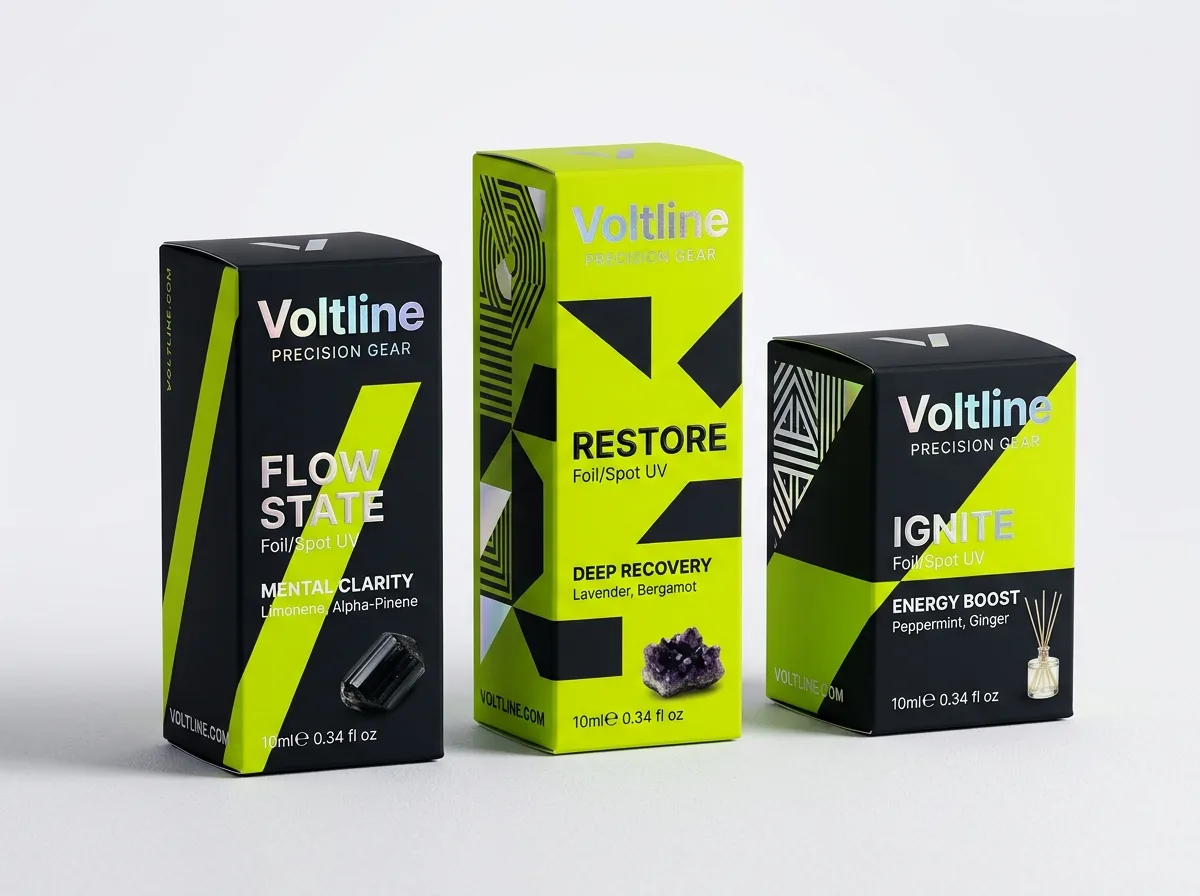
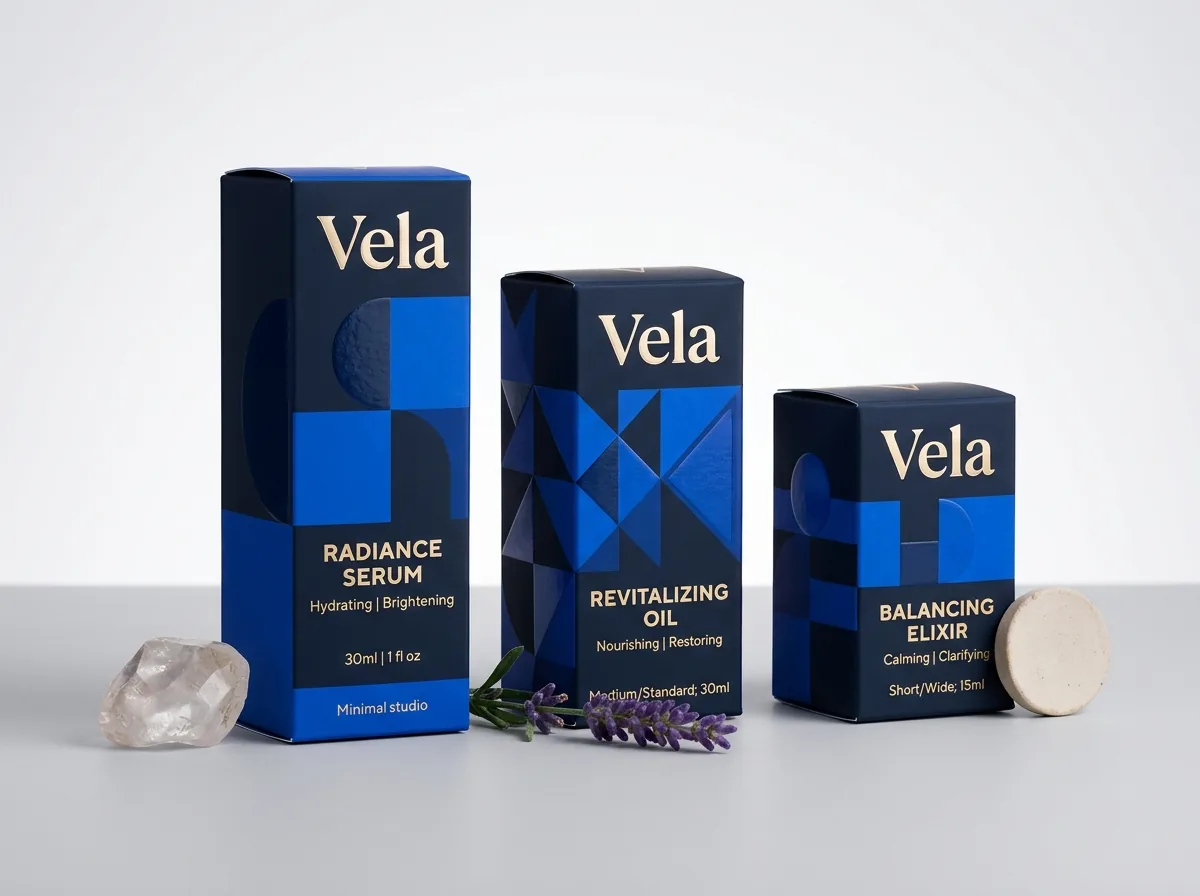
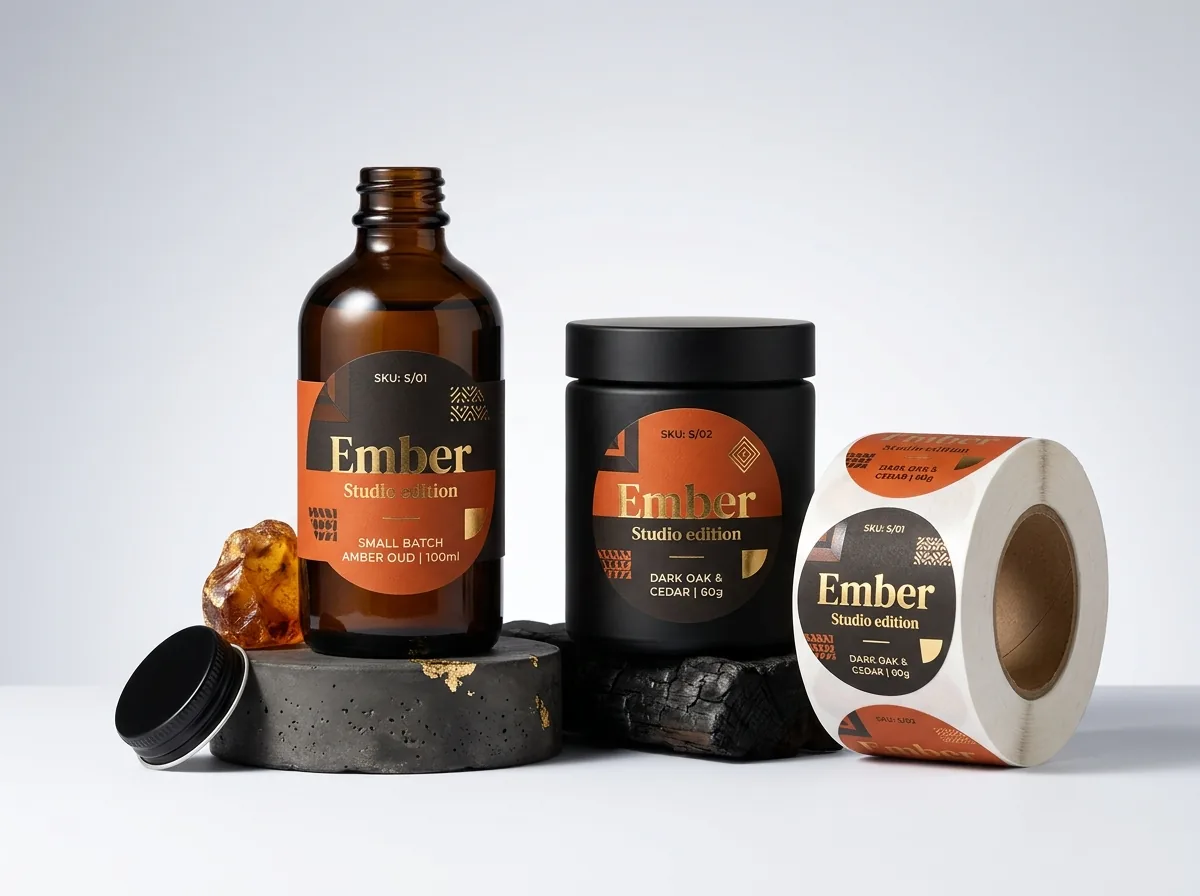
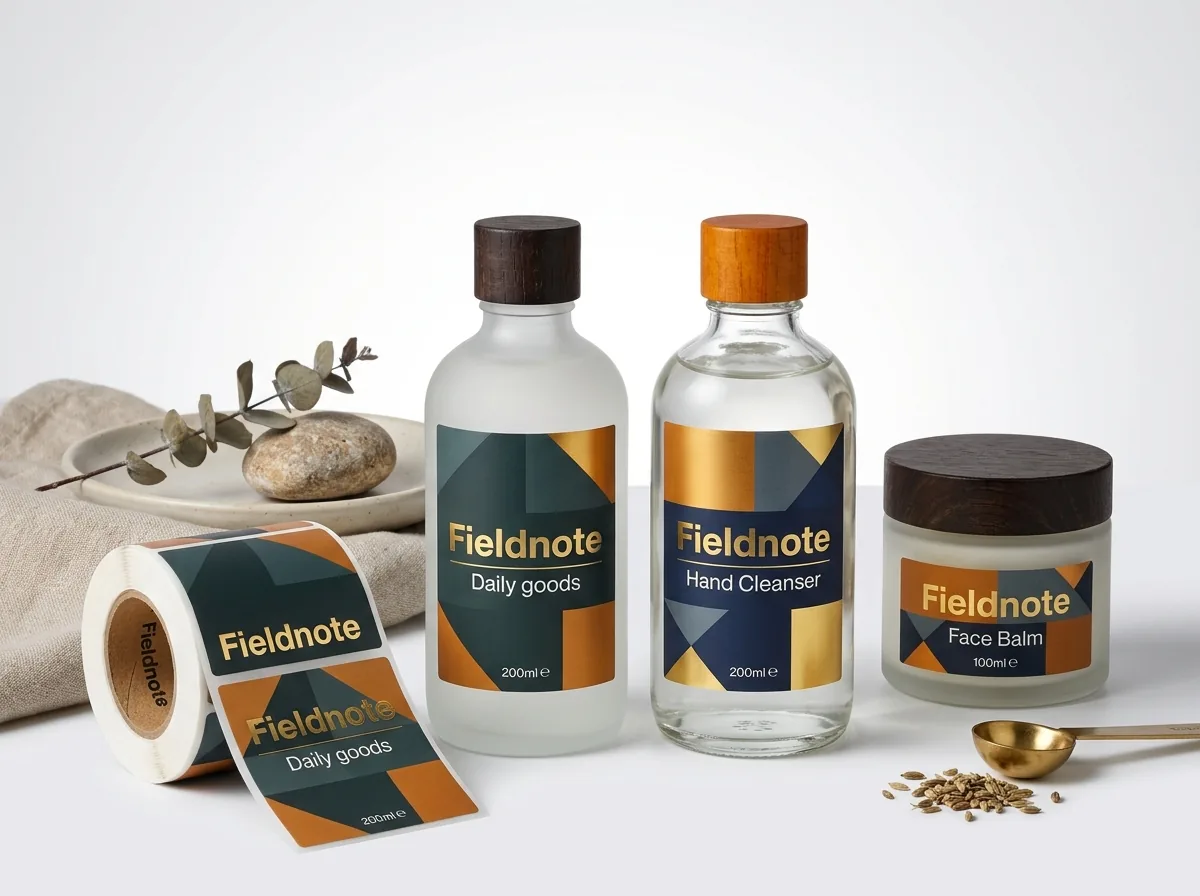
Ready to order essential oil labels? Compare up to 3 quantities with a free 3D mockup.
Request a Quote →Questions about essential oil labels
How small can text be printed on a 5 ml or 15 ml essential oil label?
On dark text over a white or light background, 5-point type is the practical minimum for crisp legibility when set in 100% K-only vector black. For light or knockout white text reversed out of a dark background, keep type at 6 points or larger.
What file format should I upload for custom essential oil labels?
Vector PDF or Adobe Illustrator (.ai) files with all fonts outlined and a 1/16 inch (0.0625 in) bleed on all four sides produce the sharpest 5-point botanical text. If you only have a logo or sketch, our team sets up your multi-scent layout for free.
How do I put a barcode on a tiny 5 ml or 10 ml essential oil bottle?
A standard retail UPC-A barcode scaled to 80% magnification requires roughly 1.18 × 0.45 inches, which crowds a 5 ml bottle wrap. Most brands either orient a truncated barcode vertically (ladder style) along the back seam or print the barcode on the outer custom essential oil box.
Can I print variable batch lot numbers or leave a blank stamp zone?
Yes. Most aromatherapy brands design a small white rectangle on the left side panel where they stamp or thermal-transfer print the GC/MS batch lot number and fill date during bottling.
What roll unwind direction should I specify for a bottle labeling machine?
Most tabletop and inline small-vial labelers use either Left Edge Leading (position 4) or Right Edge Leading (position 3) unwind on a 3 inch or 1 inch core. Share your machine model in the quote notes so we wind your rolls to match.
Still have a question? Ask a packaging specialist.
Request a Quote →Request your essential oil labels quote
Tell us your size and quantities, and one dedicated account manager prepares pricing for each tier.
- Free design & AI-to-print studio + 3D mockup
- No die or plate charges · 4–5 day rush available
- Free shipping to all 50 states
- 10% off your first order
The 3-panel wrap proportions, 5-point K-only vector typography rules, and multi-scent dieline tips in this guide are based on standard 5 ml to 30 ml euro-dropper bottle geometry and CubitPack's decided product rules in our published product specifications. A CubitPack packaging specialist reviewed every step.
Sources
What changed
- October 22, 2026: First published.
- October 22, 2026: Updated specifications, terminology, and verified source links.
More guides
New packaging guides by email
Sizes, materials and design tips. Unsubscribe anytime.