
How do I design custom spice labels for jars, tins, and shakers?
Short answer: Build one master dieline grid shared across every jar in your line: lock your brand header and net weight in fixed positions, use a color-coded Pantone band to separate culinary categories, and reserve the side or back panel for FDA ingredient lists, sesame allergen callouts, and barcodes on your custom spice labels.
On this page
- How do I build one master label template for 20+ spice blends
- What does the FDA require on retail spice and seasoning blend labels
- How do I design matching cap-topper circles and lollipop tamper seals
- How do I set up bleed, safe margins, and 5.5 pt ingredient text
- What drives the cost of custom spice labels and how do I save across SKUs
- Common mistakes
- FAQs
Request a custom quoteFree dieline & 3D mockup
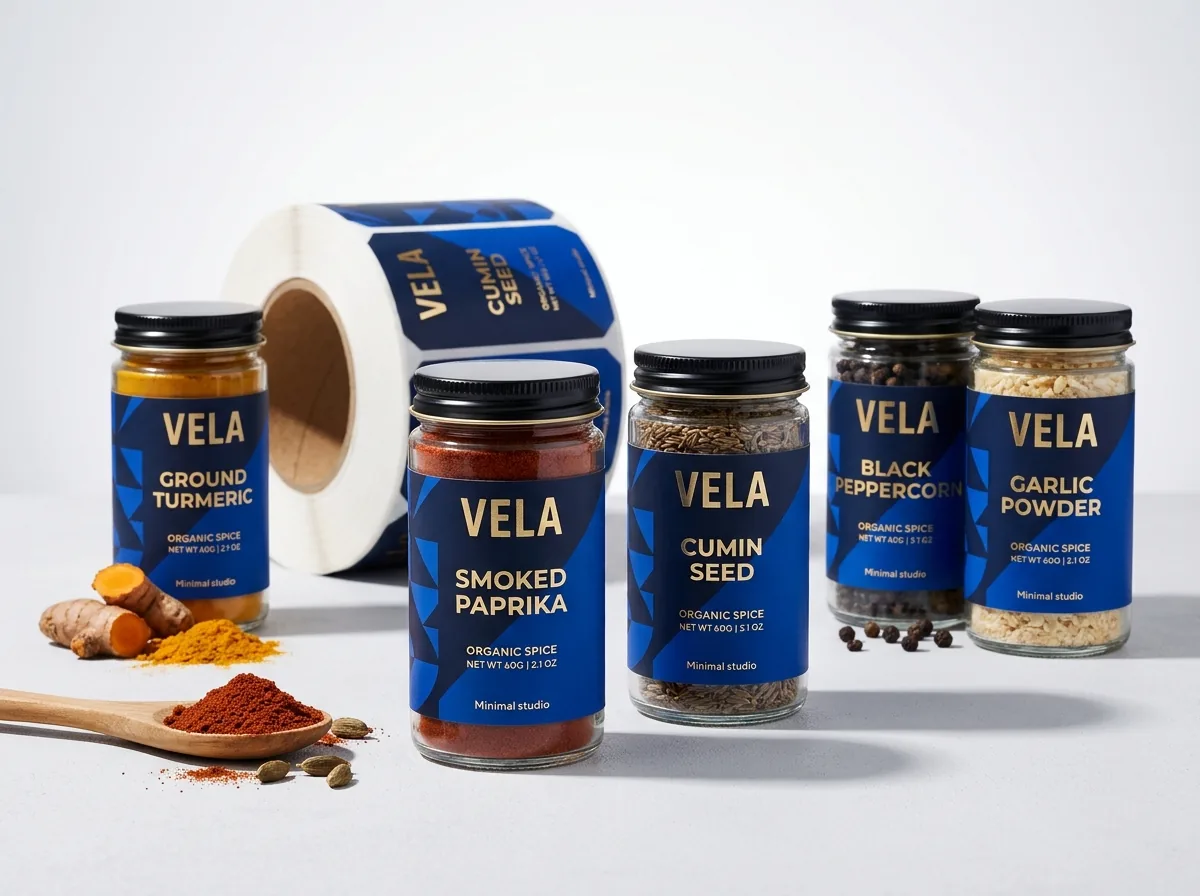
Designing spice labels is a system challenge rather than a single-label task because a growing seasoning brand often manages 10 to 40 individual herbs, single-origin spices, and dry rubs. If every jar uses a different font size or layout, your retail shelf looks cluttered and every new blend takes hours to typeset. The professional approach is a modular grid on one standard dieline (such as a 6.0 × 2.25 inch round jar wrap or a 1.5 × 2.75 inch French square panel) paired with a 1.25 or 1.5 inch round lid sticker. Keep 80% of the layout fixed and swap only the spice title, category color band, ingredient list, and UPC barcode per SKU. When you order printed spice labels from CubitPack, our prepress team checks every SKU's small text and 1/8 inch bleed for free.
How do I build one master label template for 20+ spice blends?
Before choosing colors or illustrations, collect the longest spice name and the longest ingredient list in your entire product roadmap. A minimalist layout that looks airy with the five-letter word 'CUMIN' will break completely when you launch 'CARAMELIZED ONION & ROASTED GARLIC ALL-PURPOSE RUB' with fourteen ingredients. Size your front title box to hold a two-line or three-line spice name at a consistent point size (typically 11 pt to 14 pt bold on a 4 oz jar), and group your catalog into 4 to 6 color-coded families, such as warm terracotta for chiles and BBQ rubs, sage green for culinary herbs, golden ochre for curries and baking spices, and slate blue for sea salts. That color architecture lets home cooks spot the jar they want in a split second while keeping your whole shelf line cohesive when we print your custom spice jar labels.
| Spice label zone | Where it sits on the jar | Design & typography rule |
|---|---|---|
| Brand header & origin badge | Top 25% of front panel | Fixed position across all SKUs; high-contrast logo or foil crest |
| Color-coded spice title band | Center 45% of front panel | 11–14 pt bold type; swap Pantone color band by spice category |
| Grind, heat scale & net weight | Bottom 30% of front panel | Whole vs ground note, Scoville chili icons, net oz & grams (e.g., 1.8 oz / 51 g) |
| Ingredients, allergens & packer | Back panel or left/right wrap wings | 5.5–6.5 pt high-contrast type; descending weight order + 'Contains: Sesame' |
| UPC barcode & lot/best-by box | Right wrap wing or back panel | 100% black bars on white box; unlaminated or high-contrast date stamp zone |
| Round cap-topper sticker | Top of 48-400 or 53-400 screw cap | 1.25 in or 1.5 in circle repeating the spice name and category color |
What does the FDA require on retail spice and seasoning blend labels?
Retail spices and seasoning blends sold in the United States fall under FDA food labeling regulations (21 CFR Part 101). On a single-ingredient jar (such as 100% Ground Turmeric), the front statement of identity and net weight in bothavoirdupois ounces and metric grams ('NET WT 1.9 OZ (54 g)') fulfill the core ingredient identity. On multi-ingredient seasoning blends and BBQ rubs, however, you must list all ingredients in descending order of predominance by weight on the information panel. Under 21 CFR 101.22, certain true spices may be grouped as 'spices' unless they are also colors (such as paprika, turmeric, or saffron, which must be named or declared as spice and coloring) or antigenic ingredients buyers look for (such as garlic, onion, or celery powder, which are declared by name). Most importantly, under the federal FASTER Act, sesame is one of the nine major US food allergens (alongside milk, eggs, fish, crustacean shellfish, tree nuts, peanuts, wheat, and soybeans). Any za'atar, everything bagel blend, furikake, or chili crisp rub containing sesame seeds or sesame oil must declare 'Sesame' clearly in the ingredient list or in a 'Contains: Sesame' statement.
How do I design matching cap-topper circles and lollipop tamper seals?
Designing your top lid sticker at the exact same time as your body label turns a plain spice jar into a favorite tool for home cooks. On a 1.25 inch or 1.5 inch custom circle label, skip the tiny company address and barcode; use the full circle for the bold spice name set in the same category color band as the front label so cooks can read it from standing height when they pull open a kitchen drawer. If you sell at farmers markets or wholesale grocery stores and want tamper protection without buying a heat-tunnel shrink-band machine, ask our design team to set up a custom lollipop tamper seal. A lollipop label combines your 1.5 inch top lid circle with a narrow 0.5 × 1.5 inch rectangular tail (or bridges across both sides of the cap like a barbell). Because CubitPack never charges die fees on custom shape labels, a lollipop tamper seal costs no extra tooling.
Know your size? Compare pricing across up to 3 quantities.
Request a Quote →How do I set up bleed, safe margins, and 5.5 pt ingredient text?
On a compact 1.5 × 2.75 inch French square label or a 2.0 × 2.5 inch round jar panel, every sixteenth of an inch counts. Extend your background color or pattern 0.125 inches (1/8 in) past all four edges of the cut line (or all the way around a circle's diameter) so normal blade tolerances never leave an unprinted white sliver along the edge. Keep all text, borders, heat-scale chili icons, and barcodes at least 0.125 inches inside the cut line in the safe zone. For dense ingredient lists and nutrition panels, set your text in a clean sans-serif font at 5.5 pt to 6.5 pt using 100% black ink (C0 M0 Y0 K100) on a light background rather than four-color rich black, which keeps tiny letterforms razor-sharp on press.
- Bleed: Extend background colors 0.125 in (1/8 in) outside the cut line on all sides.
- Safe zone: Keep spice names, borders, and ingredient text at least 0.125 in inside the cut line.
- Small type: Set 5.5 pt–6.5 pt ingredient lists in single-channel 100% black ink on light backgrounds.
- Vector artwork: Outline all fonts and supply vector PDF or AI files (or use our free design help).
What drives the cost of custom spice labels and how do I save across SKUs?
Four factors determine your spice label quote: label dimensions (a 1.5 × 2.75 inch single-face panel uses less material than a 7.0 × 2.5 inch BBQ shaker wrap), total combined quantity across your order, material choice (clear and metallic foil stocks vs standard stock), and specialty finishes like hot foil stamping or spot UV. The smartest way to reduce your cost per jar when launching 10, 15, or 25 seasonings is to lock every blend into the exact same container, label size, and finish. When you select 2 designs or 3+ designs in Step 2 of our quote form and list your SKU breakdown, we gang-run your entire spice catalog on one cutting setup with zero die or plate charges, 10% off your first order, and free shipping to all 50 US states. If you generated spice illustrations with an AI tool, we also prep and vectorize your files for free through our print your AI design workflow.
What are the most common spice label design mistakes?
Multi-SKU spice catalogs have moving parts that single-product labels never face. Check these five design mistakes before approving your proof
- Designing the front title box around a short word like 'SAGE' and running out of room on long blend names like 'SMOKED APPLEWOOD PORK RUB'.
- Printing the same net ounce weight on every spice SKU instead of weighing each filled jar (leaf herbs weigh a fraction of ground salts).
- Forgetting to call out 'Sesame' as a major allergen on everything bagel, za'atar, or Asian chili seasoning blends.
- Drawing a tight thin border 1/16 inch inside the cut line where normal die-cutting tolerance makes the frame look off-center.
- Setting small 5.5 pt ingredient text in four-color rich black instead of 100% K black, which can soften tiny letter edges.
Find your label size
Suggested label size: 9⅛ × 2¾ in (width × height)
A typical starting point. Your account manager confirms the size on the proof.
Quote this size →Packaging for this
Ready to order spice labels? Compare up to 3 quantities with a free 3D mockup.
Request a Quote →Questions about spice labels
How can I order 15 different spice label designs without paying 15 setup fees?
Keep the exact same width, height, shape, stock, and finish across all 15 spice designs. In Step 2 of the quote form, select 3+ designs and write your SKU list and quantities in the notes so we gang-run them together with zero die or plate fees.
Why do two 4 oz spice jars have completely different net weights on the label?
A '4 oz spice jar' refers to 4 fluid ounces of container volume, but retail food labels must state net weight by mass (ounces and grams). A 4 oz jar holds about 3.5 to 4.0 oz of dense sea salt, roughly 1.8 oz of ground paprika, and only 0.6 oz of dried parsley.
Does a single-ingredient spice jar need a Nutrition Facts panel?
Under FDA rules (21 CFR 101.9(j)(4)), plain single spices and herbs that contain insignificant amounts of all nutrients (and make no nutrient or health claims) are generally exempt from carrying a Nutrition Facts box, freeing up space on small 4 oz jars.
When do I need to list 'Sesame' as an allergen on a spice label?
Under the federal FASTER Act, sesame is one of the 9 major US food allergens. Any seasoning blend containing sesame seeds, tahini, or sesame oil must declare 'Sesame' in the ingredient list or in a 'Contains: Sesame' statement right after the ingredients.
Can your design team lay out all of my spice SKUs from one master template?
Yes. Design help is free at CubitPack. Send us your logo, color preferences, and a spreadsheet of your spice names, net weights, and ingredient lists, and our designers will build the master template and send proofs for every SKU.
Can I print matching custom spice boxes for 3-jar or 4-jar gift sets?
Yes. We produce custom spice boxes, cardboard dividers, and spice jar labels under one roof, and we guarantee an exact Pantone color match between your jar labels and outer gift cartons.
Still have a question? Ask a packaging specialist.
Request a Quote →Request your spice labels quote
Tell us your size and quantities, and one dedicated account manager prepares pricing for each tier.
- Free design & AI-to-print studio + 3D mockup
- No die or plate charges · 4–5 day rush available
- Free shipping to all 50 states
- 10% off your first order
The multi-SKU grid layout, net-weight vs jar-volume guidance, and FDA 21 CFR 101.22 / FASTER Act sesame allergen notes in this guide were compiled from federal food labeling rules and CubitPack prepress standards, and verified by a packaging specialist. Reviewed. Spot an error? Tell us and we will fix it.
Sources
What changed
- October 22, 2026: First published.
- October 22, 2026: Updated specifications, terminology, and verified source links.
More guides
New packaging guides by email
Sizes, materials and design tips. Unsubscribe anytime.