
How do I design custom knife box foam inserts, bolster locks and blade guards?
Short answer: Pinch the knife handle and bolster with a 1/64-inch interference fit in closed-cell EVA foam or a folded card neck cradle while cutting the blade channel 1/8 inch wider so the honed edge and tip hang free. Every order of custom knife boxes includes free insert dieline engineering.
On this page
- How does a bolster-lock foam or paperboard cradle prevent tip puncture
- Which insert material works best for high-carbon, Damascus and stainless blades
- Why should fixed-blade knives ship outside their leather sheaths
- How should you lay out end-cap SKU labels and Certificate of Authenticity cards
- Which print finishes hold up best in workshops, kitchens and knife shops
- Common mistakes
- FAQs
Request a custom quoteFree dieline & 3D mockup
An internal knife insert has two jobs that ordinary product trays never face: it must stop a heavy piece of sharpened steel from sliding forward like a chisel during parcel drops, and it must keep reactive blade alloys away from moisture, tannins and edge contact. If you trace the exact outline of a fixed blade or chef's knife at uniform tightness, the sharpened bevel rubs against the tray wall every time the knife is inserted or removed, and a hard end-drop can drive the point straight into the foam wall. Instead, professional cutlery inserts grip only the handle scales, bolster and finger guard while leaving clearance around the blade spine, bevel and tip-guard cap. Pair that bolster-lock geometry with handle-only finger notches, dry closed-cell EVA foam, and a scannable end-cap specification label on your printed knife boxes for safe warehouse handling and collector unboxing.
How does a bolster-lock foam or paperboard cradle prevent tip puncture?
Whether you choose a die-cut EVA foam insert or a folded cardboard insert, the secret to stopping tip blowouts is separating the retention zone from the blade zone. The retention zone wraps around the handle scales, ricasso, bolster or finger guard (the unsharpened, thickest structural shoulders of the knife). In die-cut closed-cell EVA foam, we cut the handle cavity 1/64 inch (0.4 mm) narrower than the handle profile so the foam gently squeezes the scales and forms a solid physical step in front of the bolster or guard. Once the bolster is locked against that step, the knife cannot slide lengthwise toward the end of the box. We then cut the blade channel 1/16 to 1/8 inch wider than the blade and leave 0.50 inch of solid foam beyond the polymer tip protector so the point and cutting edge float completely clear of contact.
- Handle & bolster grip: cut 1/64 in tighter than the handle width so friction and the bolster shoulder lock axial movement.
- Blade & bevel relief: cut the blade channel 1/8 in wider than the spine so the factory micro-bevel never scrapes the wall.
- Tip-guard pocket: flare the end of the blade slot slightly to fit a slip-on plastic point guard plus 0.50 in of solid end foam.
- Two-piece foam lamination: bond a die-cut top EVA profile layer to a solid 0.25-inch bottom foam pad so heavy tangs cannot touch the floor.
- Handle-only thumb wells: place two 0.6-inch half-moon finger cutouts beside the handle center of gravity, never near the blade choil.
Which insert material works best for high-carbon, Damascus and stainless blades?
Not all cushioning materials behave the same way when pressed against polished steel, brass bolsters or reactive carbon alloys (such as 1095, 52100, White #2 or Aogami Super) during months of sea freight or warehouse storage. Open-cell polyurethane sponge foam absorbs ambient humidity and can hold moisture directly against a blade face. Closed-cell EVA (ethylene-vinyl acetate) and EPE (expanded polyethylene) foams have sealed microscopic cells that do not wick moisture out of the air and provide 3x to 5x higher tear and puncture resistance under sharp metal weight. Compare the four common knife insert setups in the table below before finalizing your dieline.
| Insert material & style | Best knife & steel match | Moisture, edge & cost notes |
|---|---|---|
| Closed-cell EVA foam (38-45 kg/m³) | Titanium EDC folders, Damascus chef knives, steak sets | Dry closed cells; crisp die-cut wall; optional velvet top |
| Closed-cell EPE foam | Heavy fixed-blade hunting knives, multi-tools, whetstones | High shock absorption for courier drops; economical on deep trays |
| Folded paperboard bolster-lock tray | Stainless paring, utility & chef knives, utility cutters | 100% curbside recyclable; ships flat; pinches handle neck |
| EVA or card + VCI anti-rust sleeve | Reactive high-carbon steels (1095, 52100, Aogami, O1) | Cavity sized +0.10 in wider to fit oiled blade in VCI paper |
| Two-cavity blade + sheath divider | Bushcraft, camp & skinning knives with leather sheaths | Keeps vegetable-tanned leather tannins off the bare blade |
Why should fixed-blade knives ship outside their leather sheaths?
One of the most frequent corrosion surprises in custom bladesmithing happens when a freshly oiled fixed blade is holstered inside its vegetable-tanned leather belt sheath, sealed inside a box, and stored for 60 days. Leather is hygroscopic (it draws moisture from humid air), and vegetable tanning salts or chrome-tanning acids can etch dark spots or verdigris onto high-carbon blades and brass guards. To prevent sheath staining while still delivering a cohesive unboxing, we design a side-by-side or two-level insert inside your custom knife boxes. The knife sits in the left foam cavity wrapped in its VCI (volatile corrosion inhibitor) paper or poly sleeve with a plastic tip guard, while the leather or Kydex sheath sits in its own contoured right-hand cavity. Adding a small 2-gram silica gel desiccant recess under the sheath cavity gives extra insurance when shipping across humid coastal zones.

Know your size? Compare pricing across up to 3 quantities.
Request a Quote →How should you lay out end-cap SKU labels and Certificate of Authenticity cards?
Unlike cosmetics or food cartons that face front-out on a supermarket gondola, pocket knife and chef cutlery boxes are almost always stacked horizontally with the narrow end panel facing the aisle or stockroom picker. Leaving both narrow ends blank forces dealers and fulfillment staff to pull every box off the shelf just to check the blade steel or handle scale color. Reserve one narrow end panel (or apply a wrap-over custom seal sticker) for five essential data points: model name and number, blade steel alloy (e.g., CPM-Magnacut, M390, VG-10), Rockwell hardness (e.g., 61-62 HRC), handle scale material (e.g., Micarta, Carbon Fiber, Walnut), and a high-contrast UPC/EAN barcode. Inside the lid, pair your foam tray with a printed custom insert card listing the sharpen angle, hand-wash care instructions, and serialized maker signature.
- End-panel SKU block: model name, blade steel alloy, Rockwell hardness (HRC), blade grind/finish (Stonewashed, Satin, DLC) and handle material.
- Barcode contrast: dark black bars on a white or light cream unvarnished patch so handheld warehouse scanners read on the first pass.
- Interior COA & care card: serial number, batch heat-treat date, sharpening angle (e.g., 15° or 20° per side) and hand-wash / oil maintenance notes.
Which print finishes hold up best in workshops, kitchens and knife shops?
Cutlery boxes are handled frequently by collectors, kitchen staff and shop clerks whose hands may carry light blade oil or workshop dust. Uncoated porous paperboard smudges quickly if touched with oiled fingers. Adding a protective soft-touch lamination or matte film lamination seals the printed ink against light oil and scuffing while giving charcoal, forest-green or deep-navy cartons a refined tactile grip. For maker crests and blade silhouettes, pair soft-touch lamination with copper or gunmetal silver foil stamping and registered Spot UV tracing the ripple pattern of Damascus steel or the 1:1 profile of the knife inside. If your brand uses one master rigid box across five knife lengths, print the exterior with your core logo and apply a custom color-coded end-cap label for each blade series.
- Soft-touch lamination: resists light blade oil smudges and gives charcoal or olive boxes a low-glare tactical feel.
- Copper, gold or gunmetal foil stamping: highlights your maker's mark, anvil crest or blade steel badge on the lid.
- Registered Spot UV: traces Damascus steel layers or a 1:1 gloss blade outline against a matte background.
What are the most common knife insert and artwork mistakes?
A great knife box protects both the factory edge and the person opening the lid. Check these five structural and prepress errors before sending your files to print
- Cutting the blade foam channel to a tight friction fit instead of gripping only the handle and bolster, which rubs the honed bevel and lets the point pierce the end wall.
- Placing finger lift cutouts next to the sharpened blade belly or choil instead of beside the handle scales.
- Using open-cell sponge foam or shipping a carbon-steel blade inside a leather sheath, which traps moisture against the steel.
- Forgetting to leave an unvarnished or high-contrast end-panel zone for the model name, steel alloy (Magnacut, S35VN, VG-10), handle finish and barcode.
- Skipping hand-wash and honing-angle care instructions on culinary knife boxes, leading buyers to run forged chef knives through commercial dishwashers.
Find your size
Suggested inside size: 5.5 × 2.0 × 1.25 in
A starting point. Your account manager confirms the size with you before the proof.
Quote this size →Packaging for this
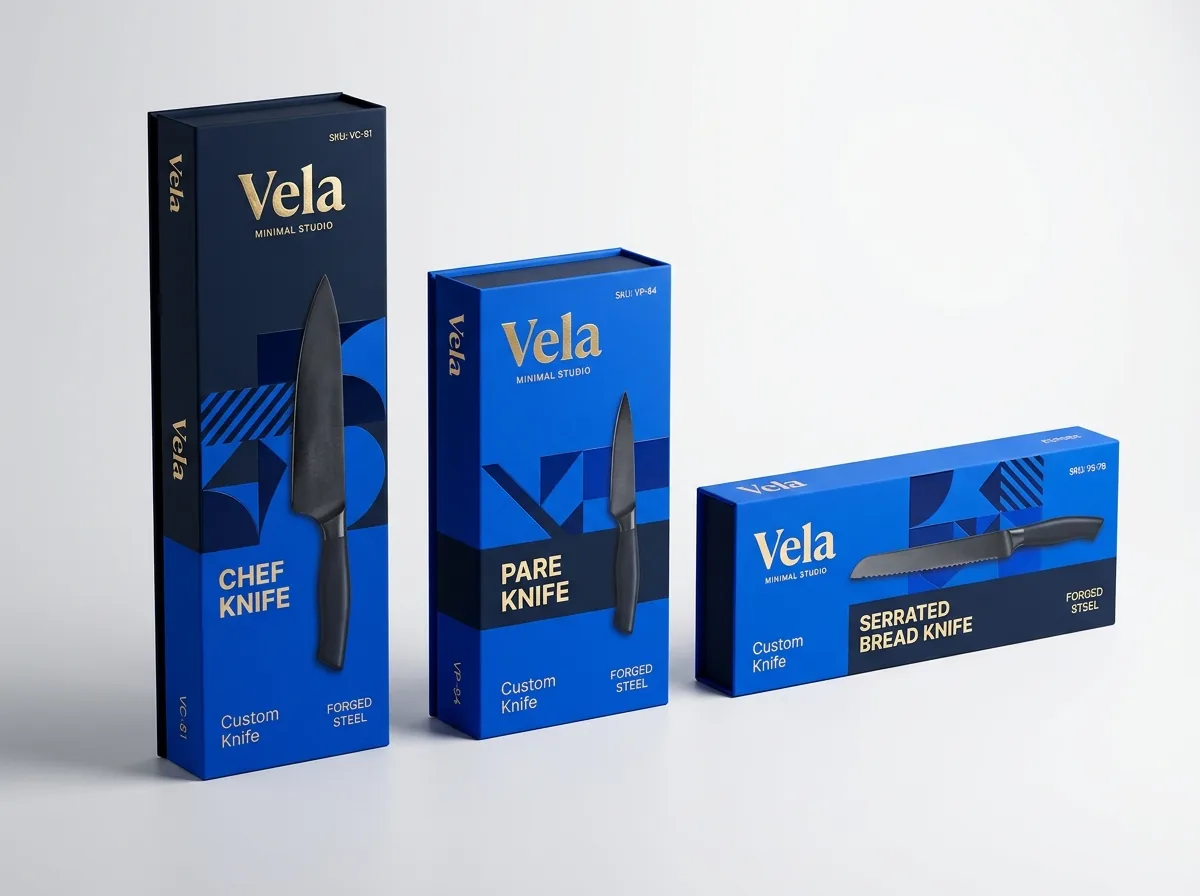
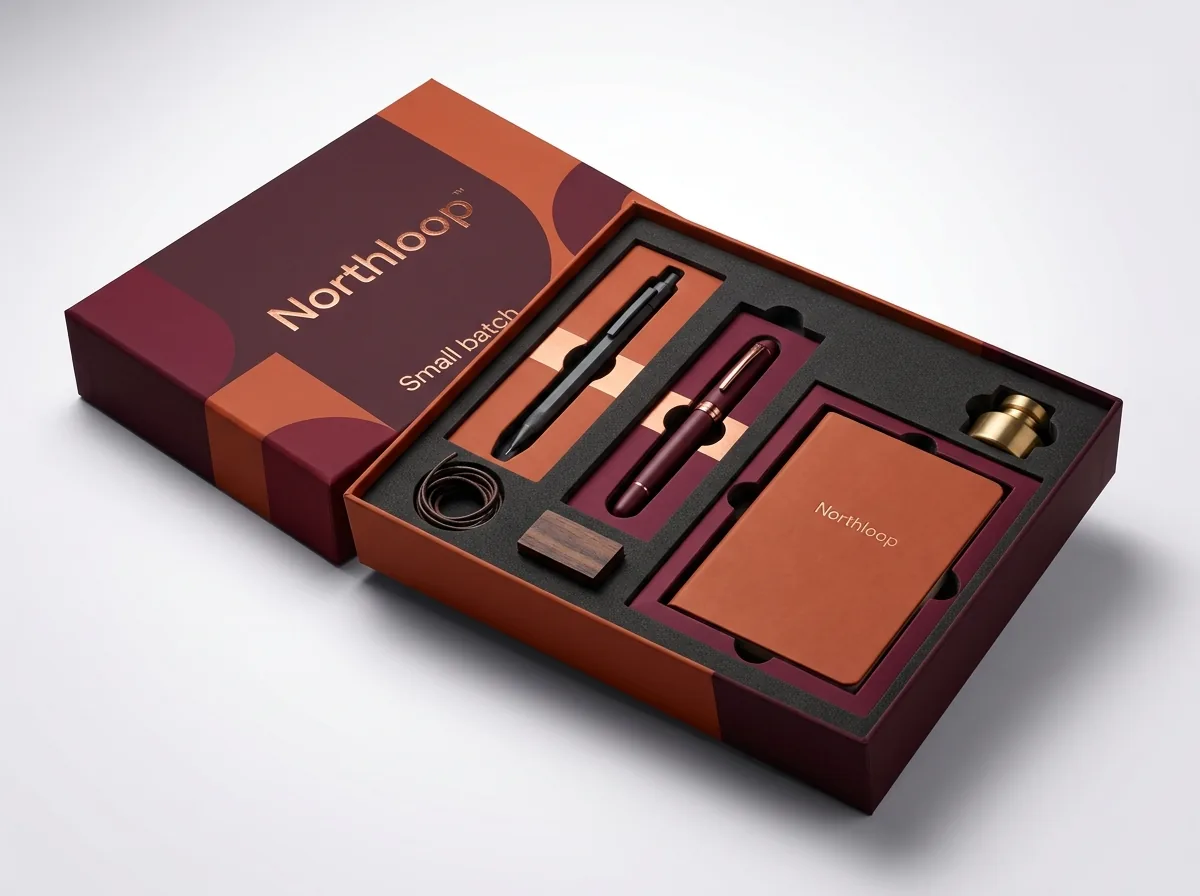



Ready to order knife boxes? Compare up to 3 quantities with a free 3D mockup.
Request a Quote →Questions about knife boxes
How do I send my knife profile so you can design the die-cut EVA foam insert?
You can send a 2D vector outline (DXF, AI or PDF at 1:1 scale), a 3D STEP file, or a flat top-down photograph of your knife and sheath next to a ruler. Our structural team builds the bolster-lock foam dieline for free.
Can you add a velvet or flocked paper top layer over the EVA foam insert?
Yes. We can laminate black, charcoal, burgundy or forest-green velvet flocking (or a smooth matte card top sheet) onto the top surface of the closed-cell EVA foam for presentation chef knives and collector folders.
Should a culinary knife box still use a plastic tip guard if it has a foam insert?
Yes. A tiny slip-on polymer tip guard costs pennies and adds a hard mechanical cap over the needle point of a gyuto or paring knife, working together with our bolster-lock cavity and 0.5-inch end foam buffer.
Can I print sharpening angles and care instructions inside the lid of the box?
Yes. Inside lid printing works great on folding cartons, mailers and hinged magnetic rigid boxes, letting you print factory bevel angles (such as 15° vs 20°), whetstone grit steps and hand-wash care rules without a separate booklet.
How do knife brands handle multiple steel or handle scale variants without printing 10 boxes?
Print one master knife box design and leave a clean framing box on the narrow end panel. We can print matching roll or sheet end-cap labels for each steel alloy (Magnacut, S35VN, Damascus) and handle material (Micarta, G10, Titanium).
Do you offer physical prototypes to test drop performance before full production?
Yes. Every order includes a free vector dieline, digital proof and 3D mockup before payment, and you can order a physical fitted sample of your box and foam insert to test handle retention and drop safety.
Still have a question? Ask a packaging specialist.
Request a Quote →Request your knife boxes quote
Tell us your size and quantities, and one dedicated account manager prepares pricing for each tier.
- Free design & AI-to-print studio + 3D mockup
- No die or plate charges · 4–5 day rush available
- Free shipping to all 50 states
- 10% off your first order
The bolster-lock geometry, closed-cell EVA/EPE moisture guidelines, and end-cap labeling practices in this guide reflect standard cutlery packaging engineering and ASTM/ISTA cushioning principles. A CubitPack packaging specialist checked every section. Spot an error? Tell us and we will fix it.
Sources
What changed
- October 22, 2026: First published.
- October 22, 2026: Updated specifications, terminology, and verified source links.
More guides
New packaging guides by email
Sizes, materials and design tips. Unsubscribe anytime.