
What size knife box do I need for pocket, hunting and chef knives?
Short answer: Measure the overall length, widest guard or handle height, and handle thickness (including any pocket clip), then add 0.5 inch per side for an EVA foam border. Common custom knife boxes are 5.5 × 2.0 × 1.25 in for EDC folders and 14.5 × 3.5 × 1.5 in for 8-inch chef's knives.
On this page
- How do I measure a folding pocket knife vs a fixed blade for a custom box
- What are standard inside dimensions for EDC, hunting and culinary knife boxes
- How do you size a knife box when packing a sheath, pouch or COA card
- How much foam clearance prevents blade tips from piercing the box end
- How do I calculate box dimensions for a 3-piece culinary trio or steak knife set
- Common mistakes
- FAQs
Request a custom quoteFree dieline & 3D mockup
Sizing a knife box starts with whether the blade folds into the handle or stays fixed at full length, and whether a pouch, sheath or sharpening accessory ships beside it. For a folding everyday carry (EDC) pocket knife, measure the closed handle length, closed width from spine to scale edge, and total thickness including the pocket clip and pivot hardware. For a fixed-blade hunting knife or culinary chef's knife, measure total length from pommel butt to blade point with the polymer tip-guard cap installed, maximum blade heel height, and maximum bolster or handle thickness. Add at least 0.50 inch at both ends (1.0 inch total to Length) and 0.375 to 0.50 inch along the top and bottom walls (0.75 to 1.0 inch total to Width) so the die-cut EVA foam or paperboard cradle surrounds the steel with a rigid crush zone. Every order of printed knife boxes from CubitPack is cut to your exact inside dimensions with zero die fees.
How do I measure a folding pocket knife vs a fixed blade for a custom box?
Always measure the complete production knife with every included protective sleeve, tip guard, pocket clip and pouch sitting on your bench. On a folding pocket knife, the closed handle is your length baseline, but the spring pocket clip and thumb studs add 0.15 to 0.25 inch to the handle thickness that a flat CAD drawing of the scales alone can miss. On a fixed-blade culinary or outdoor knife, install the plastic tip protector and VCI anti-rust paper sleeve before taking your tip-to-pommel length. Write your final inside dimensions as Length × Width × Height in inches, where Length is the long horizontal span of the knife, Width is the front-to-back depth across the blade heel and handle height, and Height is the vertical thickness from the bottom floor to the top lid. Entering those three numbers when quoting custom knife packaging lets our design team builds your outer carton and inner cradle dielines together.
- Overall Length (L): take closed handle length (for folders) or pommel-to-tip-guard length (for fixed blades) and add 0.50 in of foam buffer at each end (add 1.0 in total).
- Front-to-back Width (W): take the tallest point of the knife (usually the chef blade heel, finger guard or folded blade spine) and add 0.50 in per side (add 1.0 in total).
- Side-by-side sheath allowance (+W): if a leather or Kydex sheath sits parallel to a fixed blade, add the sheath width plus a 0.50 in foam bridge wall between the two cavities.
- Vertical Height (H): take handle + clip thickness, add 0.25 in for the bottom foam floor, and add 0.50 in underneath if a microfiber pouch, Torx tool and COA card stack in a lower well.
- Handle-only thumb notches: reserve two 0.6-inch half-moon finger cutouts on opposite sides of the handle balance point so fingers lift the handle cleanly.
What are standard inside dimensions for EDC, hunting and culinary knife boxes?
Although CubitPack cuts every carton, drawer sleeve and rigid box to your exact sixteenth of an inch with no tooling charges, most pocket knives, bushcraft blades, kitchen knives and multi-piece sets fall into nine standard size brackets. Use the table below to benchmark your layout before measuring your physical knife and sheath. Notice how EDC folder boxes stay compact (5.0 to 7.5 inches long) so knife dealers can stack dozens of SKUs end-out on narrow showcase shelves, while culinary gyuto, Santoku and slicer boxes stretch 13.5 to 16.5 inches long with a low 1.5-inch profile that slides flat into kitchen drawers or courier mailers.
| Knife type & included accessories | Typical inside size (L × W × H) | Usual box & insert setup |
|---|---|---|
| Compact slipjoint or gentleman's folder (under 3 in blade) | 5.0 × 1.75 × 1.0 in | Reverse tuck carton or mini drawer box |
| Standard EDC folding knife (3.0-3.5 in blade) + pouch | 5.5 × 2.0 × 1.25 in | Drawer box or straight tuck + 2-tier EVA |
| Large tactical folder, OTF knife or heavy multi-tool | 7.5 × 2.5 × 1.5 in | Tray and sleeve or two-piece + EVA cavity |
| 3.5-to-4-inch culinary paring or petty utility knife | 9.5 × 2.5 × 1.25 in | Two-piece rigid or tuck carton + neck cradle |
| Fixed-blade hunting / bushcraft knife + leather sheath | 11.5 × 3.5 × 1.75 in | Two-piece rigid or E-flute mailer + 2-slot foam |
| 7-inch Santoku, nakiri vegetable knife or boning knife | 13.5 × 3.25 × 1.5 in | Two-piece rigid box + bolster-lock EVA |
| 8-inch western chef's knife or 210mm Japanese gyuto | 14.5 × 3.5 × 1.5 in | Two-piece or magnetic book rigid box |
| 10-inch brisket slicer, carving knife or bread knife | 16.5 × 3.75 × 1.5 in | Heavyweight two-piece rigid + EVA base |
| 4-piece or 6-piece steak knife set or 3-knife chef trio | 11.5 × 7.5 × 2.0 in | Magnetic book rigid chest + multi-slot foam |
How do you size a knife box when packing a sheath, pouch or COA card?
Two accessory layouts dominate modern knife packaging: the stacked two-level well for EDC folders, and the side-by-side dual cavity for sheathed fixed blades. In an EDC folder box, stacking the zippered nylon or microfiber pouch, cleaning cloth, sticker and serialized Certificate of Authenticity (COA) underneath the top EVA foam layer keeps the box footprint small (5.5 × 2.0 inches) while adding just 0.50 inch to the vertical Height. For a fixed-blade hunting, camp or skinning knife, bladesmiths avoid shipping high-carbon steel inside a vegetable-tanned leather sheath because leather holds moisture and tannins that can stain the blade during storage. Placing the wrapped knife and the empty sheath side by side in a 11.5 × 3.5 × 1.75 inch or 12.0 × 4.25 × 1.75 inch box displays both pieces immediately when the lid lifts off. If you also pack hand tools or outdoor gear, compare our custom tool boxes and custom sports equipment boxes for heavy-duty layouts.
Know your size? Compare pricing across up to 3 quantities.
Request a Quote →How much foam clearance prevents blade tips from piercing the box end?
When a parcel containing a 9-ounce chef's knife or hunting blade is dropped end-first onto concrete, the steel acts like a chisel trying to slide forward through the box wall. Leaving a hollow gap in front of the point is not enough if the knife can slide along its slot. Instead, we engineer the EVA foam insert or cardboard insert with a stepped bolster lock: the handle and finger guard sit in a snug 1/64-inch friction-fit pocket that physically blocks forward motion, while the blade channel is cut 1/8 inch wider than the spine and stops 0.50 to 0.75 inch short of the outer end wall. That way, even under repeated courier drops, the handle shoulder absorbs the impact against the foam bridge and the sharp point floats untouched in open air.
How do I calculate box dimensions for a 3-piece culinary trio or steak knife set?
To size a presentation chest for a 3-piece kitchen starter set (such as an 8-inch chef's knife, 5-inch utility knife and 3.5-inch paring knife) or a 4-to-6-piece table steak knife set, start with the longest knife in the set plus 1.0 inch of end-to-end foam border (0.50 inch at each end) to establish your inside Length. To find the inside Width, add the individual heel-to-spine heights of all the knives in the set, add 0.50 to 0.625 inch of solid foam bridge between each adjacent knife so fingers can reach into the handle notches without touching the neighboring blade spine, and add 0.50 inch of outer border at the top and bottom edges. For four steak knives that each measure 9.25 inches long by 0.90 inch tall, that math yields a clean 10.5 × 6.25 × 1.75 inch or 11.5 × 7.5 × 2.0 inch magnetic closure or two-piece rigid chest. If your culinary set also includes a 9-inch honing steel or a dual-grit whetstone block, add one extra horizontal slot with a 0.75-inch foam wall separating the heavy stone from the adjacent blade.
- 3-piece culinary starter trio (8 in chef, 5 in utility, 3.5 in paring): 14.5 × 6.5 × 1.75 in inside dimensions.
- 4-piece forged steak knife presentation set: 10.5 × 6.25 × 1.75 in or 11.5 × 7.5 × 2.0 in inside dimensions.
- 6-piece forged steak knife chest: 11.5 × 9.5 × 2.0 in with 0.50 in foam bridges between every handle.
What are the most common knife box sizing mistakes?
Almost every knife packaging failure comes from ignoring axial blade slide or forgetting the thickness of clips, sheaths and tip guards. Check these five before approving your dieline
- Measuring the bare blade tip-to-butt without installing the plastic tip-guard cap, which adds 0.20 to 0.35 inch to the overall length.
- Cutting a straight-walled slot that lets the knife slide forward on drop impact instead of pinching the handle bolster to stop axial movement.
- Forgetting the spring pocket clip on an EDC folder, which adds up to 0.25 inch to the handle thickness and makes the top lid bulge.
- Sizing a fixed-blade cavity with the knife inside its leather sheath, trapping moisture against high-carbon steel during warehousing.
- Leaving less than 0.50 inch of foam bridge between parallel steak or culinary knives, leaving no room for safe finger lift notches around the handles.
Find your size
Suggested inside size: 5.5 × 2.0 × 1.25 in
A starting point. Your account manager confirms the size with you before the proof.
Quote this size →Packaging for this
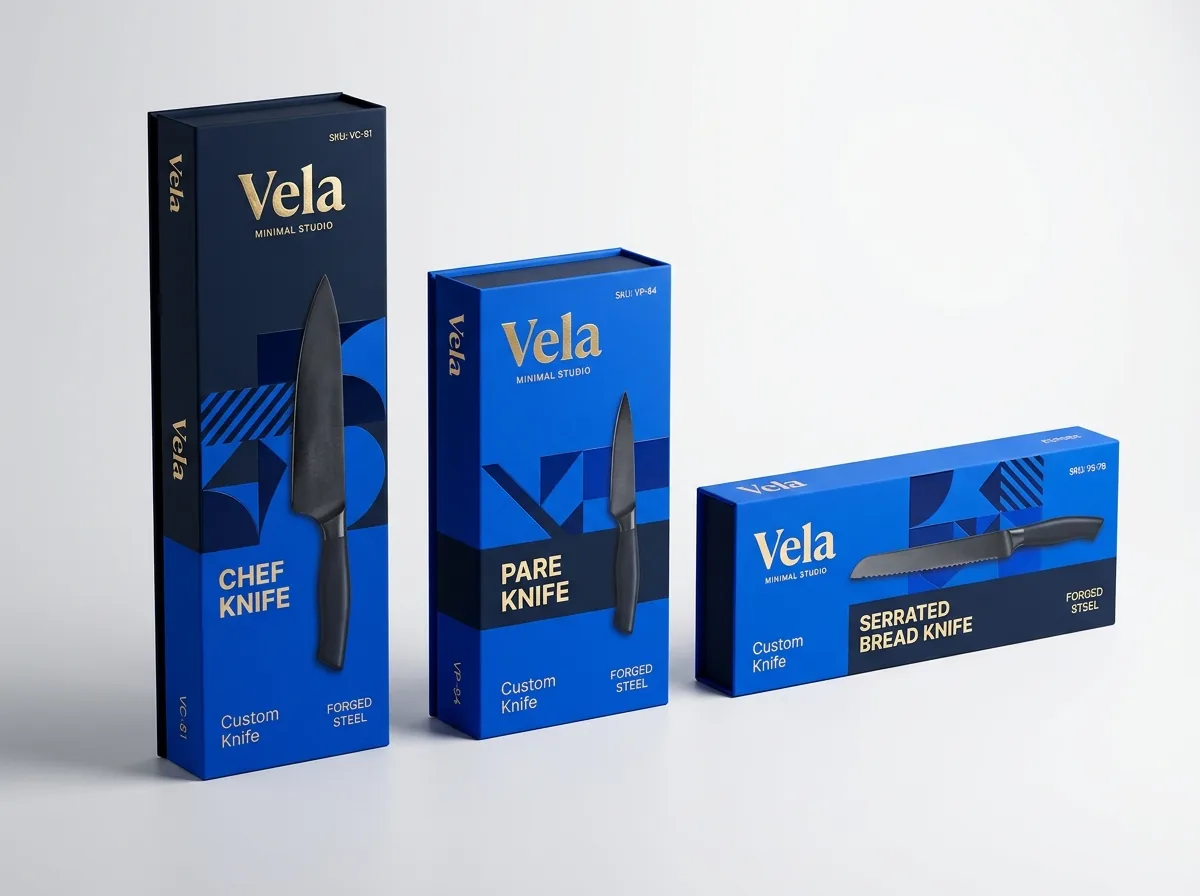
Ready to order knife boxes? Compare up to 3 quantities with a free 3D mockup.
Request a Quote →Questions about knife boxes
What size box fits a standard 3.25-inch blade EDC folding pocket knife?
A standard EDC folder with a 3.25-inch blade typically measures 4.25 to 4.50 inches closed and fits cleanly into a 5.5 × 2.0 × 1.25 inch drawer box or tuck carton, leaving room for an EVA foam border and a lower pouch pocket.
What size box do I need for an 8-inch chef's knife or 210mm Japanese gyuto?
Most 8-inch western chef's knives and 210mm gyutos measure 13.0 to 13.5 inches overall from pommel to tip guard and 1.8 to 2.1 inches tall at the heel. A 14.5 × 3.5 × 1.5 inch two-piece rigid box fits them with a 0.5-inch perimeter buffer.
Can I use one outer box size for an 8-inch chef, 7-inch Santoku and 8-inch bread knife?
Yes. Size the outer box around your longest and tallest knife (usually 14.5 × 3.5 × 1.5 inches) and customize only the internal EVA foam cutout or paperboard neck lock for each blade profile so all three share one box run.
How thick should the bottom foam pad be under a heavy fixed-blade knife?
We recommend a 0.25-inch (6 mm) solid foam floor bonded underneath a 0.50-to-0.75-inch die-cut top cavity layer so heavy steel tangs and brass bolsters never bottom out against the cardboard base.
Do you charge extra die fees for a custom contoured knife foam cutout?
No. CubitPack never charges die or plate fees. Your custom outer box dieline and your contoured EVA foam or paperboard bolster-lock insert are engineered with zero tooling charges.
Can I test my knife, tip guard and sheath in a physical sample before full production?
Yes. Every quote includes a free vector dieline, digital proof and 3D mockup before payment, and you can request a physical prototype of your box and foam insert to verify handle grip and tip clearance.
Still have a question? Ask a packaging specialist.
Request a Quote →Request your knife boxes quote
Tell us your size and quantities, and one dedicated account manager prepares pricing for each tier.
- Free design & AI-to-print studio + 3D mockup
- No die or plate charges · 4–5 day rush available
- Free shipping to all 50 states
- 10% off your first order
The sizing formulas and category benchmarks in this guide are based on standard EDC folder closed lengths, western and Japanese culinary knife geometry (paring, Santoku, 210mm gyuto, 10-inch slicer), and 0.50-inch closed-cell EVA foam perimeter tolerances. A CubitPack packaging specialist checked every row. Spot an error? Tell us and we will fix it.
Sources
What changed
- October 22, 2026: First published.
- October 22, 2026: Updated specifications, terminology, and verified source links.
More guides
New packaging guides by email
Sizes, materials and design tips. Unsubscribe anytime.