
Folding carton vs two-piece rigid vs drawer knife boxes: which should you choose?
Short answer: Choose folding cartons (from 1,000 units) for high-volume utility blades and paring knives, slide-drawer boxes for EDC pocket folders, and two-piece or magnetic rigid boxes (from 50 units) for long chef's knives and collector blades. Compare all custom knife boxes by blade length and weight.
On this page
- How do the five main knife box structures compare side by side
- Why do EDC pocket knife brands prefer drawer boxes over standard tuck cartons
- Why do 8-inch and 10-inch chef's knives need two-piece rigid or E-flute boxes
- When should you upgrade to a magnetic book-style box for collector or steak knives
- How do flat storage and dealer shelf stacking affect your knife box choice
- Common mistakes
- FAQs
Request a custom quoteFree dieline & 3D mockup
Picking the right structure for a knife comes down to three physical factors: overall blade span, steel weight, and whether the customer keeps the box as a permanent storage case. A single-wall folding carton ships flat, pops open quickly on the packing bench, and keeps unit cost low at 1,000+ units for 3-to-5-inch closed pocket knives, replacement blades and paring knives. Once a box stretches to 12 to 17 inches for a fixed-blade bushcraft knife or an 8-inch chef's knife, thin paperboard can flex along its length unless reinforced by an E-flute corrugated wall (starting at 250 units) or a dense chipboard two-piece or magnetic rigid box (starting at 50 units). For mid-tier and titanium EDC folders, a tray-and-sleeve drawer box gives double-wall end protection and a smooth ribbon pull. Every style of printed knife boxes includes free dielines and zero die fees.
How do the five main knife box structures compare side by side?
Cutlery brands and custom bladesmiths rely on five core structures depending on whether the knife sells on a hardware store peg hook, stacks end-out in a specialty knife dealer showcase, or ships direct to a chef or collector. Use the table below to compare minimum order quantities, span stiffness, flat storage and insert compatibility before locking your quote. Notice how the minimum order quantity scales inversely with board thickness: folding cartons require 1,000 units because they run on high-speed folding-gluing lines, whereas two-piece telescopic and magnetic book-style rigid boxes start at just 50 units for small-batch forged runs.
| Box structure & minimum | Best knife applications | Span stiffness & storage |
|---|---|---|
| Reverse / straight tuck carton (1,000 min) | Entry EDC folders, utility knives, paring blades | Ships 100% flat; best for spans under 8 inches |
| Tray-and-sleeve drawer box (1,000 card / 50 rigid) | Titanium EDC folders, tactical knives, multi-tools | Double-wall tray stops end-flap blowouts |
| E-flute corrugated mailer (250 min) | Hunting knives with sheaths, DTC whetstone kits | Fluted wall resists bending on 10-to-15-inch spans |
| Two-piece telescopic rigid box (50 min) | 8-to-10-inch chef's knives, gyutos, custom fixed blades | Ships pre-assembled; zero flex on 14-to-17-inch spans |
| Magnetic book-style rigid box (50 min) | Damascus collector knives, 4-to-6-piece steak sets | Hinged hardcover spine with hidden magnet latch |
Why do EDC pocket knife brands prefer drawer boxes over standard tuck cartons?
A folded titanium or G10 pocket knife packs 3.5 to 6.5 ounces of concentrated steel into a compact 4.5-inch handle. In a basic reverse-tuck carton without an inner tray, dropping the box end-first allows that dense handle to ram straight against the tuck flap and pop it open. A custom drawer box (or a tray and sleeve box) eliminates end-flap blowouts because the knife rests inside a four-walled inner tray while the outer sleeve wraps completely around the perimeter. When the buyer pulls the grosgrain ribbon tab on the end of the tray, the drawer glides out horizontally to reveal the knife nested in die-cut EVA foam on top, with a hidden lower compartment underneath holding the zippered microfiber pouch, pivot sticker, Torx bit and serialized Certificate of Authenticity.
Why do 8-inch and 10-inch chef's knives need two-piece rigid or E-flute boxes?
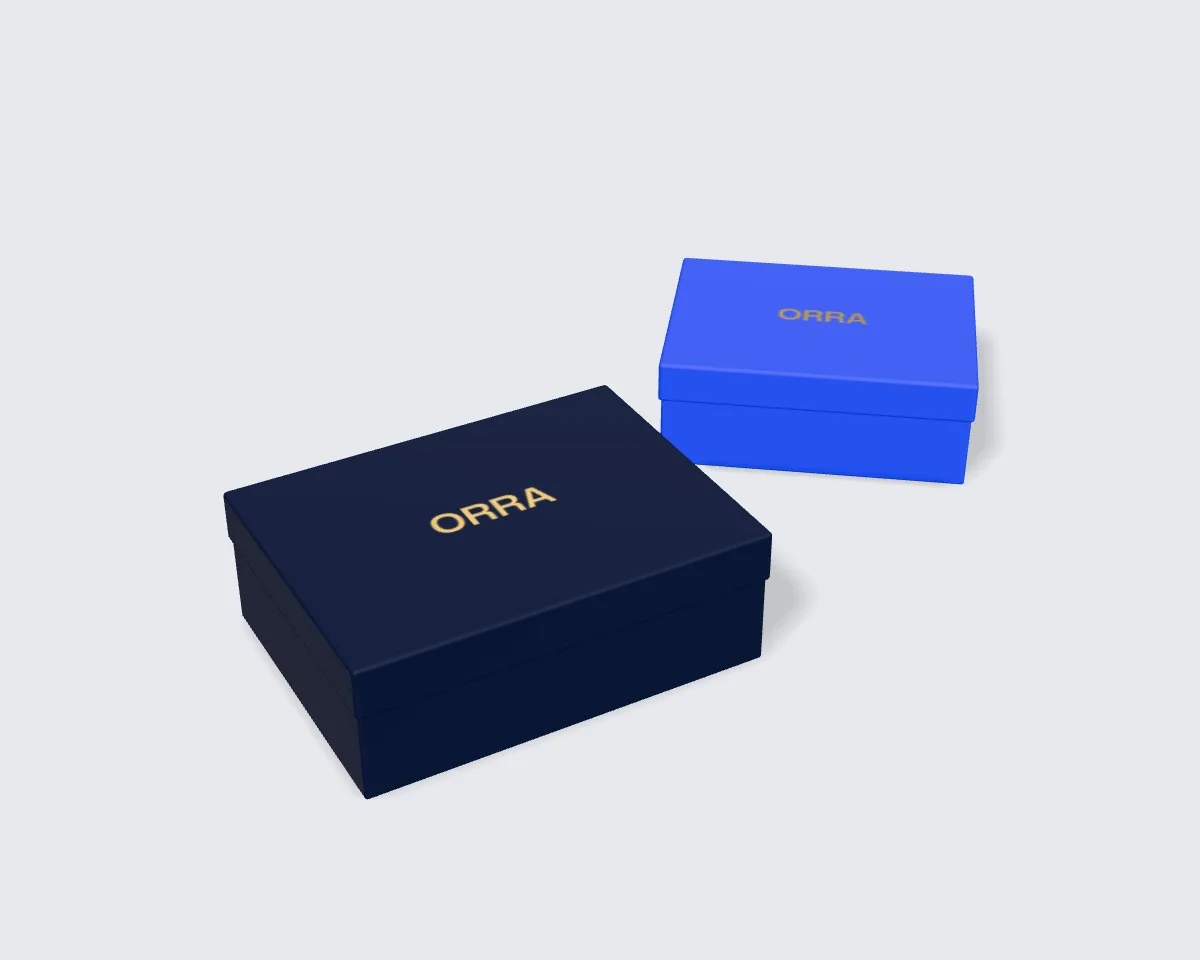
An 8-inch western chef's knife or 210mm Japanese gyuto requires an inside box length of 14.0 to 15.0 inches, and a 10-inch brisket or bread slicer stretches to 16.5 inches. Across a 15-inch span, an unreinforced single-wall paperboard carton acts like a long lever: picking the box up by one end causes the middle to sag or twist. A two-piece rigid box solves span flex by wrapping printed paper over dense rigid chipboard and nesting a full-height telescopic lid over the base walls, doubling the vertical sidewall thickness along the entire 15-inch length. If you need a box that ships flat to save warehouse space, an E-flute custom mailer box or corrugated sleeve provides fluted beam stiffness across long culinary spans while starting at 250 units. Many direct-to-consumer kitchen cutlery brands also pair a two-piece rigid presentation box with a matching outer E-flute corrugated shipping box so the matte black or copper-foil gift box arrives at the customer's kitchen without courier scuff marks or shipping labels stuck to the lid.
- Under 8 inches overall (closed EDC folders, utility knives): single-wall folding cartons or compact slide-drawer boxes hold their shape cleanly.
- 8 to 12 inches overall (paring knives, camp blades, hunting knives): E-flute corrugated mailers, tray-and-sleeve boxes or two-piece rigid boxes stop end blowouts.
- 13 to 18 inches overall (8-inch gyutos, Santokus, 10-inch slicers): two-piece telescopic rigid boxes or magnetic book-style rigid boxes eliminate middle span bow.
Know your size? Compare pricing across up to 3 quantities.
Request a Quote →When should you upgrade to a magnetic book-style box for collector or steak knives?
When a customer buys a hand-forged Damascus hunting blade, a numbered limited-edition folder, or a 4-to-6-piece forged steak knife set, the box is rarely thrown away; instead, it serves as the permanent countertop or drawer storage case between uses. A magnetic closure box built in a book-style hinged format opens flat on the kitchen counter so every knife handle can be lifted out and returned to its individual bolster-notched EVA foam slot after washing and drying. The inside of the hinged top lid also gives you a wide flat canvas for printing steel tempering charts, whetstone sharpening angles (such as 15 degrees per side), or attaching diagonal corner ribbons to hold a signed Certificate of Authenticity.
- Reverse or straight tuck carton: lowest unit cost at 1,000+ units; ships 100% flat; ideal for paring knives, utility blades and entry folders.
- Slide-out drawer box: double-wall end strength; two-tier foam storage for knife + microfiber pouch; favorite of EDC collectors.
- E-flute corrugated mailer: ships flat from 250 units; crush-resistant flutes for fixed bushcraft knives with leather sheaths.
- Two-piece telescopic rigid box: zero middle flex on 14-to-17-inch chef knives; starts at 50 units for custom and mid-sized runs.
- Magnetic book-style rigid box: hinged keep-case for Damascus collector pieces and 4-to-6-piece table steak knife chests.
How do flat storage and dealer shelf stacking affect your knife box choice?
Before choosing between folding cartons, corrugated mailers and rigid boxes for your custom knife boxes, check two operational details: how much pallet space you have in your workshop, and how brick-and-mortar knife dealers store your inventory. Folding cartons and E-flute mailers ship flat on pallets and take up roughly one-seventh the storage volume of pre-assembled rigid boxes. If you want rigid chipboard presentation for a 15-inch chef's knife without dedicating multiple pallet bays to empty setup boxes, ask for a collapsible (foldable) magnetic rigid box that ships flat and folds into shape with corner adhesive strips. Regardless of which structure you choose, specialty knife shops stack boxes horizontally with the narrow 2.0 × 1.25 inch or 3.5 × 1.5 inch end panel facing outward. Designing a clean, scannable end-cap graphic with the model name, blade steel and barcode works across tuck flaps, drawer ends and rigid base walls alike.
- Flat-shipped structures (tuck cartons, paperboard tray-and-sleeve, E-flute mailers, collapsible rigid): store thousands of units on a single workshop shelf.
- Pre-assembled rigid structures (two-piece telescopic, rigid drawer, rigid book-style): zero assembly folding time on the packing bench; foam comes pre-glued inside.
- End-out dealer stacking: place SKU number, steel alloy (Magnacut, S35VN, VG-10), handle material and UPC barcode on the narrow end panel.
What are the most common mistakes when choosing a knife box style?
Matching a heavy or long steel blade to the wrong box structure leads to bowed cartons, popped end flaps or wasted warehouse space. Avoid these five mistakes
- Using a thin single-wall tuck carton on a 15-inch chef's knife without an E-flute or rigid board core, causing the box to bow in the middle.
- Packing a heavy 6-ounce titanium pocket knife in a light tuck box without an inner tray or auto-lock stop, allowing the end flap to pop open.
- Ordering pre-assembled two-piece rigid boxes for a 5,000-unit run without checking pallet storage space, when a collapsible rigid or folded drawer box would ship flat.
- Placing a ribbon pull tab on the long side of an EDC drawer box instead of the narrow end, which makes the tray bind as it slides out.
- Using a magnetic flap closure without a recessed EVA foam handle lock on a 6-piece steak knife set, allowing blades to shift if the chest is carried vertically.
Find your size
Suggested inside size: 5.5 × 2.0 × 1.25 in
A starting point. Your account manager confirms the size with you before the proof.
Quote this size →Packaging for this

Ready to order knife boxes? Compare up to 3 quantities with a free 3D mockup.
Request a Quote →Questions about knife boxes
What is the minimum order for folding carton vs rigid custom knife boxes?
Custom folding carton knife boxes start at 1,000 units, E-flute corrugated mailer knife boxes start at 250 units, and two-piece telescopic, slide-drawer or magnetic closure rigid knife boxes start at just 50 units.
Can a slide-out drawer knife box be made in either paperboard or rigid board?
Yes. At 1,000+ units, we can engineer a double-wall folded paperboard tray-and-sleeve drawer box that ships flat. From 50+ units, we also make pre-assembled chipboard rigid drawer boxes with ribbon pulls.
Which box style is strongest for shipping a heavy fixed-blade hunting knife by mail?
An E-flute corrugated mailer box (starting at 250 units) or a two-piece rigid box paired with a die-cut EVA or EPE foam insert absorbs parcel drops best and prevents the heavy tang from bursting the ends.
Can I get a collapsible rigid box for long chef's knives to save storage space?
Yes. Collapsible (foldable) magnetic rigid boxes ship flat and pop up with corner adhesive strips or hidden magnets, giving you rigid chipboard presentation for chef knives in a fraction of the warehouse space.
Do two-piece rigid knife boxes come with the EVA foam insert already glued inside?
Yes. On pre-assembled two-piece, drawer and magnetic rigid knife boxes, we bond the die-cut EVA foam cradle directly into the base tray so your packing team can drop the knife straight in.
Can I compare unit prices for two different knife box styles in one quote?
Yes. Tell your account manager in the quote notes if you want to compare a folding tray-and-sleeve box against a rigid drawer or two-piece box, and we will quote both side by side in 5-7 minutes.
Still have a question? Ask a packaging specialist.
Request a Quote →Request your knife boxes quote
Tell us your size and quantities, and one dedicated account manager prepares pricing for each tier.
- Free design & AI-to-print studio + 3D mockup
- No die or plate charges · 4–5 day rush available
- Free shipping to all 50 states
- 10% off your first order
This comparison draws on CubitPack's decided minimums (1,000 folding cartons, 250 mailers, 50 rigid boxes) in our published product specifications and standard structural span and drop-protection principles for EDC folders, hunting blades and culinary chef knives. A CubitPack packaging specialist reviewed every table row. Spot an error? Tell us and we will fix it.
Sources
What changed
- October 22, 2026: First published.
- October 22, 2026: Updated specifications, terminology, and verified source links.
More guides
New packaging guides by email
Sizes, materials and design tips. Unsubscribe anytime.