
How do steam vents and grease barriers keep takeout burgers crisp?
Short answer: Place die-cut steam notches on the rear hinge corners and side walls rather than the flat top lid, and pair a grease-resistant inner barrier or butter paper wrap with breathable paperboard or E-flute board. When you order custom burger boxes from CubitPack, custom vent cutouts and push-in lid tabs add zero die cost.
On this page
- Why do rear corner hinge notches beat holes punched in the top lid
- Which vent and grease-holdout setup matches your burger build
- Interior grease-barrier liner vs custom butter paper wrap: do you need one or both
- How do die-cut push tabs and tamper stickers speed up your expo and delivery line
- How do you get custom vents, tabs, and inside printing without extra tooling fees
- Common mistakes
- FAQs
Request a custom quoteFree dieline & 3D mockup
A freshly griddled burger leaves the pass at 160 to 175 degrees Fahrenheit, releasing a continuous plume of water vapor for the first 12 minutes inside the carton. In an unvented or foam container, that vapor hits the roof of the lid, condenses into water droplets, and rains straight back down onto the toasted crown bun while patty juices pool under the bottom heel bun. Keeping a delivery burger crisp requires two things working together: side-to-rear cross-ventilation that lets excess moisture escape even when boxes are stacked three high in a courier bag, and an interior grease holdout system (either a food-safe inner barrier coating on request or a custom butter paper sheet) that stops melted cheese and special sauce from wicking into the paperboard fibers. At CubitPack, custom rear corner vents and push-in lid tabs are built into your dieline with zero die fees.
Why do rear corner hinge notches beat holes punched in the top lid?
Look at a generic stock takeout carton and you will often see two or four small circles punched into the dead center of the flat top lid. On a single box sitting open on a kitchen counter, top holes vent steam upward just fine. The problem starts 30 seconds later when an expo worker stacks three burger boxes on top of each other inside a paper takeout bag. The flat bottom of the upper box sits directly on top of the flat lid of the lower box, sealing top-lid holes shut and trapping rising vapor against the cardboard floor above it. When we engineer a custom dieline for printed burger clamshells, we place curved thumb-sized steam notches along the angled rear hinge corners and the upper side wall seams. Because clamshell walls taper inward toward the top and bottom, the rear corners sit recessed inside the stack perimeter - creating an open horizontal chimney that vents moisture even when four boxes are stacked tight.
- Rear hinge corner notches: stay 100% unobstructed when boxes are stacked vertically in a delivery bag.
- Front tab-slot gap: leaving a 1/16-inch air gap around the front lock tab lets cool air enter low while warm vapor exits high out the back.
- Intact top billboard: moving vents off the top lid leaves the entire top panel uninterrupted for your restaurant logo.
- Drip protection: eliminates top holes where sauce or condensation from an upper box could drip onto the burger below.
Which vent and grease-holdout setup matches your burger build?
Different burger styles release very different amounts of steam and oil. A dry-griddled single slider on a toasted potato roll needs far less grease protection than a double smashburger dripping with caramelized onions and house sauce, or a buttermilk fried chicken sandwich whose breading softens the instant steam gets trapped. Use the table below to pair your menu item with the right vent geometry and interior grease protection.
| Burger build | Recommended vent placement | Best grease-holdout setup |
|---|---|---|
| Single/double smashburger (wrapped) | 2 rear hinge corner notches | Custom butter paper wrap inside kraft or card box |
| Unwrapped half-pound brioche pub burger | 2 rear corner notches + 2 side seam slots | Grease-resistant inner liner on request + E-flute board |
| Crispy fried chicken / fish burger | Extra-wide rear corner notches + side slots | Breathable E-flute board + parchment cradle sheet |
| Burger + french fries combo meal | 4 corner vents (extra venting over fry bay) | Grease-resistant liner + pop-up divider wall |
| 3-slider flight trio box | Dual wide back-wall slots across 9.25 in span | Waxed or butter-paper trough sheet under all 3 sliders |
| Saucy BBQ / mushroom Swiss burger | 2 rear corner vents | Full wrap in greaseproof paper + lined base floor |
Interior grease-barrier liner vs custom butter paper wrap: do you need one or both?
Nothing ruins a takeout unboxing faster than a dark translucent grease ring soaking through the bottom of the clamshell and staining the customer's car seat or office desk. Restaurants prevent oil strike-through in two ways: ordering boxes with an interior food-safe grease barrier on request (), or wrapping the burger in a sheet of custom butter paper before placing it into the clamshell. If your line cooks place unwrapped burgers directly onto the floor of the clamshell (common with tall gourmet brioche burgers pinned with a bamboo skewer and open burger-and-fry combo trays), specify a food-safe interior grease barrier on your quote so melted cheddar and beef tallow cannot wick into the board fibers. If you serve smashburgers where wrapping the burger half-way or full-way in paper holds the melted cheese and sauce together while eating, a custom printed butter paper sheet handles the direct grease contact and lets you use a standard unlined kraft or white card outer clamshell.
Know your size? Compare pricing across up to 3 quantities.
Request a Quote →How do die-cut push tabs and tamper stickers speed up your expo and delivery line?
Because CubitPack cuts every custom burger dieline with zero die or plate charges, you can build functional kitchen workflow tools directly into the cardboard at no extra per-box cost. The most popular upgrade is a row of perforated push-in dimple tabs along the top rim of the lid labeled Single, Double, Chicken, Plant, No Onion, or Spicy. As the grill cook closes the box, their thumb presses down the matching tab in half a second - eliminating smeared grease-pencil writing and mix-ups at the bag station. For third-party courier orders, pair the front clamshell lock tab with a 2-inch circle or 1.5 × 4 inch strip of custom seal stickers bridged across the front seam. The sticker locks the front lip shut so the clamshell cannot pop open inside a biker's backpack, gives the customer visible tamper evidence, and leaves the rear corner steam vents completely free to breathe.
- Push-in protein tabs: Single, Double, Triple, Crispy Chicken, Grilled Chicken, Veggie / Plant.
- Modifier & temp tabs: Cheese, No Pickles, Gluten-Free Bun, Spicy, Med-Rare, Well.
- Front tamper-evident seal target: a printed 2-inch circle guide across the front closure seam for fast sticker placement.
- Inside-lid reheating & review QR: print a 3-minute air-fryer crisp-up tip and a review QR code inside the lid.
How do you get custom vents, tabs, and inside printing without extra tooling fees?
Many packaging suppliers charge extra tooling fees if you ask to move steam vents from the top lid to the rear corners, add push-in patty indicator tabs, or notch the side walls for taller skewers. At CubitPack, there are never any die or plate charges on your custom order. Every cutout, perforation, score line, and corner vent is part of your single flat cutting die, which our structural designers build for free before you pay. If you want to keep your per-box unit cost as low as possible at the 1,000-box minimum, print a bold one-color or two-color Pantone design on unbleached custom kraft boxes, standardize one clamshell size across your 4-inch bun menu using push-in lid tabs, and order your matching custom french fry boxes in the same production wave.
- Zero die charges: rear corner vents, thumb notches, and push-in protein tabs add no tooling cost.
- One SKU for multiple burgers: use perforated lid tabs instead of printing separate boxes for beef, chicken, and plant burgers.
- Inside-lid branding: add a one-color slogan inside the lid so every open food photo carries your name.
What are the most common burger box venting and grease mistakes?
Soggy buns and oil-stained takeout bags almost always come from one of these five design oversights
- Punching steam holes in the flat center of the top lid, where stacked boxes block them and trap moisture inside.
- Packing hot fried chicken sandwiches or double smashburgers into unvented boxes that turn crispy breading rubbery in 8 minutes.
- Putting unwrapped, buttery brioche burgers directly onto uncoated paperboard without a grease barrier or butter paper liner.
- Sealing the entire perimeter of a burger box with wide packing tape instead of using a front tamper sticker and rear corner vents.
- Stocking four separate printed box SKUs for beef, chicken, double, and veggie burgers instead of one box with push-in lid tabs.
Find your size
Suggested inside size: 3.75 × 3.75 × 2.75 in
A starting point. Your account manager confirms the size with you before the proof.
Quote this size →Packaging for this
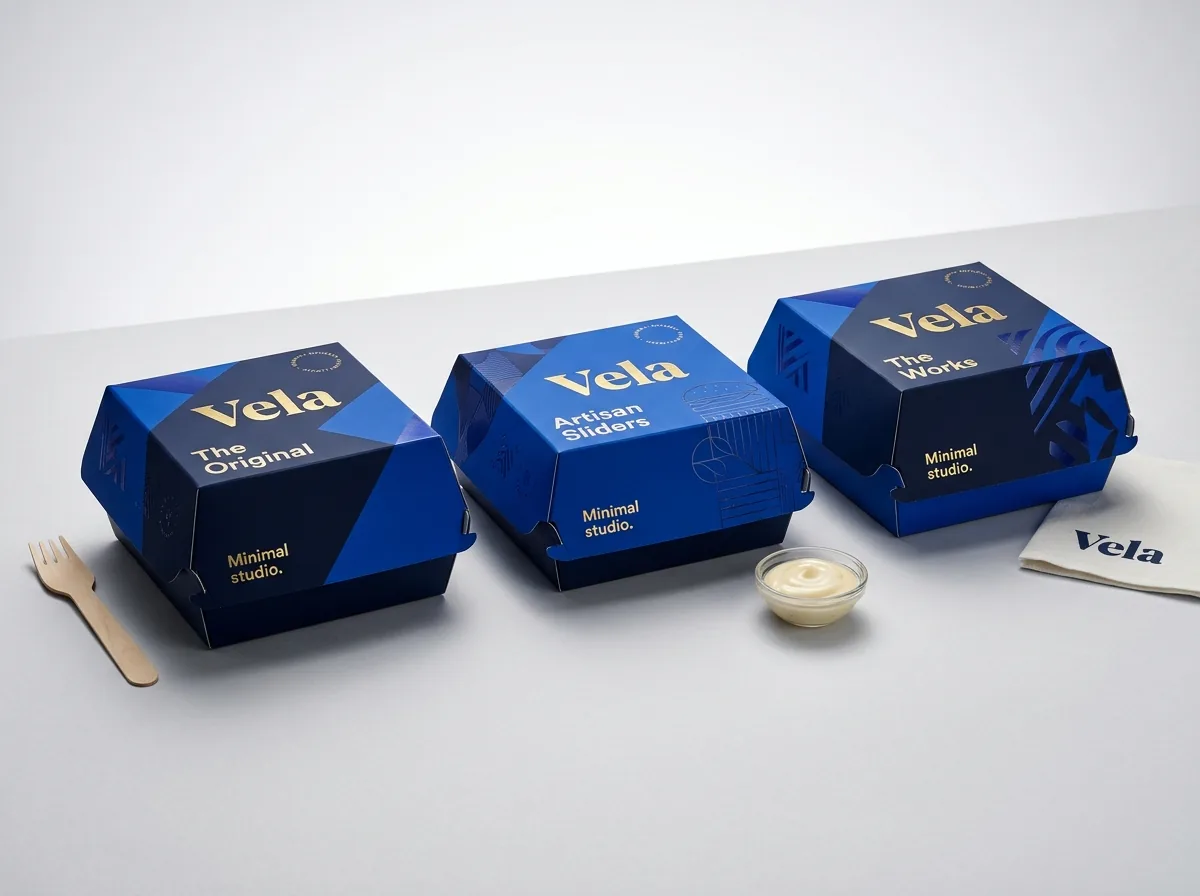
Ready to order burger boxes? Compare up to 3 quantities with a free 3D mockup.
Request a Quote →Questions about burger boxes
Where should steam vents be placed on a custom burger clamshell?
Place steam vents on the rear hinge corners and upper side wall seams rather than the flat top lid. Because clamshell walls angle inward toward the top and bottom, rear corner notches stay open to release steam sideways even when four boxes are stacked in a delivery bag.
Do custom steam vents or push-in lid tabs cost extra for cutting dies?
No. CubitPack never charges die or plate fees. Rear corner steam notches, side air slots, and perforated push-in tabs (such as Single, Double, Chicken, or Veggie) are built into your custom cutting die at no extra cost.
Are food-safe grease-resistant liners available for custom burger boxes?
Yes. Food-safe boards and grease-resistant interior barriers are available on request through our certified partner facilities. Tell us on your quote if unwrapped burgers or fries touch the board directly.
Should I wrap burgers in butter paper if my burger box already has vents?
Wrapping smashburgers half-way or full-way in custom butter paper is still a great idea: it holds melted cheese and sauce around the bun while the customer eats, keeps the inside of the box clean, and lets steam vent out the top of the wrap and through the rear box corners.
How do I make burger boxes tamper-evident for third-party delivery apps?
Add a custom printed seal sticker across the front tab-and-slot closure of the clamshell. The sticker shows the customer immediately if the lid was opened in transit while leaving the rear corner vents open so the bun stays crisp.
Can I review the exact vent and tab positions before my boxes are printed?
Yes. Every order includes free structural design help, a flat digital dieline proof showing every cut and score line, and an interactive 3D mockup before you pay.
Still have a question? Ask a packaging specialist.
Request a Quote →Request your burger boxes quote
Tell us your size and quantities, and one dedicated account manager prepares pricing for each tier.
- Free design & AI-to-print studio + 3D mockup
- No die or plate charges · 4–5 day rush available
- Free shipping to all 50 states
- 10% off your first order
The ventilation geometry and grease-holdout recommendations in this guide are based on hot-food vapor convection in stacked courier bags and foodservice packaging guidelines. A CubitPack packaging specialist verified every detail. Spot an error? Tell us and we will fix it.
Sources
What changed
- October 22, 2026: First published.
- October 22, 2026: Updated specifications, terminology, and verified source links.
More guides
New packaging guides by email
Sizes, materials and design tips. Unsubscribe anytime.