
How do you set up a hang tab box dieline, Euro/delta/round hole specs, and prepress artwork?
Short answer: Set up a hang tab box dieline by hinging the top tuck lid on the front panel (never the back panel), extending a tapered 1.0 to 1.5 inch hang tab from the center of the rear panel with a horizontal fold-down base crease, and keeping at least 0.25 inches of board around the peg hole.
On this page
- What are the structural zones of a one-piece hang tab box CAD dieline
- What are the exact CAD dimensions for round, delta triangle, and Euro sombrero hang holes
- How do the front-hinged top lid and fold-flat tab crease work together
- How do you set up bleed, safe zones, and coatings on a hang tab box dieline
- Common mistakes
- FAQs
Request a custom quoteFree dieline & 3D mockup
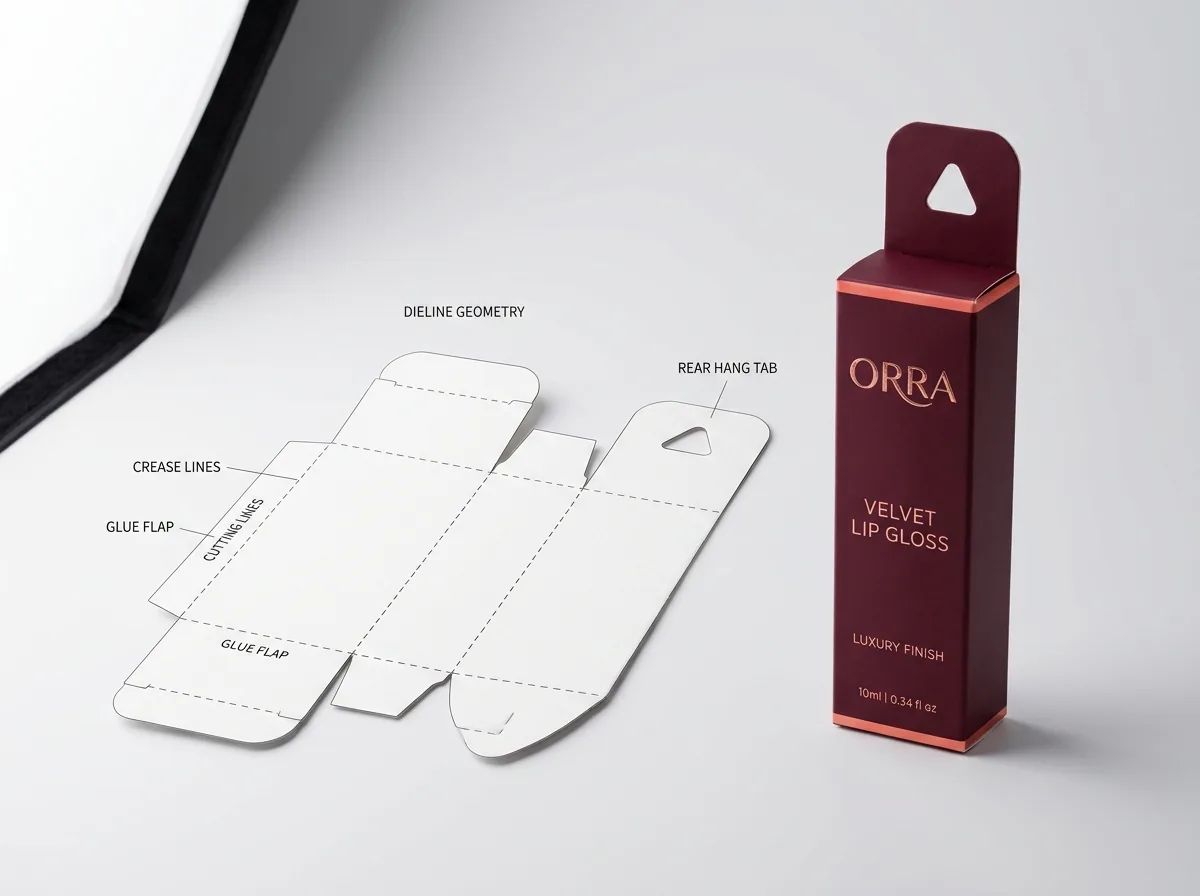
Engineering a press-ready CAD dieline for custom hang tab boxes requires coordinating the rear hanging tab with the top closure flaps so both die-cut cleanly from a single sheet of 16 pt to 24 pt paperboard. Because the center of the rear top crease is occupied by the integrated pop-up hang tab (TH = 1.00 to 1.50 inches), the top closure lid must hinge off the front panel (Panel 3) and fold backward across the top opening so its friction or slit-lock tuck flap slides down right in front of the upright tab. At the base of the hang tab, 15 to 25 degree tapered gusset shoulders widen into the rear panel to resist torsional twisting on peg hooks, while a horizontal fold-down crease lets the tab lie flat inside shipping cartons. Finally, match your hole knife (round, delta triangle, or Euro sombrero) to carton width so at least 0.25 in of side shoulder and 0.3125 in of top bridge remain.
What are the structural zones of a one-piece hang tab box CAD dieline?
When unfolded flat on a CAD table, a one-piece pop-up hang tab carton occupies nearly the exact same sheet area as a standard straight tuck end box because the 1.00 to 1.50 inch rear hang tab nests inside the vertical height already required by the front-hinged top lid and tuck flap. Review the six structural zones across custom lip gloss boxes and custom eyeliner boxes
- Zero wasted sheet height on single-ply tabs: Because the front-hinged top lid (depth W) plus its tuck flap (0.625 in) already extends 1.50 to 2.25 inches above the top score line on Panel 3, a 1.25-inch single-ply hang tab on Panel 1 adds zero extra sheet height.
- Optional 180-degree double-ply fold-over tab: For 8 to 12 oz cables or pen sets, extend the tab upward by 2 × TH with a double-rule crown crease and mirror-registered peg holes so the tab folds and glues into a 36–48 pt double ply.
- Horizontal paperboard grain: Always run board grain parallel to the horizontal top lid crease so long wood fibers run horizontally across the hang tab neck.
| CAD dieline zone | Flat dimension formula | Knife & crease rule spec | Mechanical function |
|---|---|---|---|
| Side manufacturer glue flap | 0.50 to 0.625 in wide × H tall | 15–30 deg tapered cut · Unvarnished | Bonds Panel 1 to Panel 4 on the folder-gluer |
| Back panel (Panel 1) | Width = L · Height = H | Top crease carries integral hang tab | Primary rear wall resting against pegboard |
| Integral rear hang tab | Height TH = 1.00–1.50 in above H | 15–25 deg tapered sides + base score | Houses peg hole; folds 90 deg flat for shipping |
| Left & Right side panels (2 & 4) | Width = W · Height = H | Top dust flaps with slit-lock shoulders | Support front-to-back depth and lock top lid |
| Front panel (Panel 3) + Top Lid | Width = L · Lid depth = W + tuck flap | Hinges on Front Panel; tucks to back | Opens and closes cleanly in front of hang tab |
| Bottom closure flaps | Depth = 0.55 W to 0.75 W | Friction tuck, 1-2-3 lock, or auto-bottom | Secures bottom floor for 1 oz to 12 oz SKUs |
What are the exact CAD dimensions for round, delta triangle, and Euro sombrero hang holes?
Steel-rule die makers punch three standard retail pegboard cutouts into paperboard hang tabs. Choosing the right profile and maintaining proper shoulder and bridge clearances across custom mascara boxes and custom cable boxes ensures your cartons slide onto store fixtures without binding or tearing: During steel-rule die fabrication, the punch knives that form a Euro slot, delta triangle, or round pin hole are CNC-bent from hardened single-bevel or center-bevel tool steel and fitted with high-density closed-cell ejection rubber around both the outer perimeter and the internal punch cavity. If the corner radii of a delta or Euro slot are drawn sharper than 0.0625 in (1.6 mm), the meeting points of the steel rule create localized stress risers in the paperboard fibers that can initiate microscopic corner radial cracks during high-speed platen stripping. Specifying tangent 0.0625 in to 0.0938 in corner radii and verifying clean matrix stripping on the pressroom makeready sheet ensures smooth, burr-free slot edges that slide effortlessly across chrome peg hooks.
- Corner radii on delta and Euro slots (R >= 0.0625 in / 1.5 mm): Never draw sharp 90-degree or acute unrounded interior corners on a delta triangle or Euro slot; rounding interior corners to at least 1.5 mm stops stress-concentration tears.
- Tapered 15 to 25 degree tab base gussets: Tapering the outer edges of the hang tab wider where it meets the rear crease prevents the tab neck from creasing sideways when shoppers pull adjacent boxes.
- Dust flap shoulder clearance (-0.0625 in / -1.5 mm): Trim the rear inner corners of the left and right top dust flaps back by 1.5 mm so they never rub against the base of the hang tab.
| Hang hole profile | Standard cutout dimensions | Min. tab width & box width (L) | Min. top bridge & side shoulders |
|---|---|---|---|
| Round peg hole | 0.3125 to 0.375 in (8.0–9.5 mm) dia | Tab >= 0.875 in · Box L >= 0.875 in | Top bridge >= 0.3125 in · Sides >= 0.25 in |
| Delta triangle slot | 0.750 to 0.875 in W × 0.375 in H | Tab >= 1.375 in · Box L >= 1.375 in | Top bridge >= 0.3125 in · Sides >= 0.25 in |
| Mini Euro sombrero slot | 1.000 in W × 0.3125 in H (25 × 8 mm) | Tab >= 1.500 in · Box L >= 1.625 in | Top bridge >= 0.3125 in · Sides >= 0.25 in |
| Standard Euro sombrero slot | 1.250 in W × 0.375 in H (32 × 9.5 mm) | Tab >= 1.750 in · Box L >= 2.000 in | Top bridge >= 0.3750 in · Sides >= 0.25 in |
How do the front-hinged top lid and fold-flat tab crease work together?
Two small crease details on the upper dieline determine whether your hang tab box packs smoothly on your fulfillment line and arrives uncrushed at the store across custom vape cartridge boxes and custom pen boxes: Prepress operators must also account for fold-over registration tolerances when preparing artwork for a double-ply reinforced hang tab. Because paperboard caliper creates a finite bend radius along the horizontal fold-over score line, the rear folded ply shifts vertically by approximately 0.5 to 1.0 times the board thickness during folding and gluing. Extending background ink bleed 0.125 in past the outer tab contour and enlarging the rear-ply punch cutout by 0.015 in (0.4 mm) radially prevents white paperboard slivers or double-cut edge steps from showing inside the finished peg slot.
- Front-hinged top lid with rear friction or slit-lock tuck: Because the hang tab rises from the center of the Back Panel (Panel 1), the top lid hinges off the Front Panel (Panel 3) and tucks down right in front of the hang tab.
- Nickel-notched or continuous base crease on the hang tab: Adding a light horizontal crease rule along the base of a single-ply hang tab lets fulfillment workers fold the tab 90 degrees forward over the closed top lid so cartons pack flush inside master shipping boxes.
- Optional perforated tear-away tab: If a retail chain displays half your inventory on peg hooks and half standing in counter trays, a 50% cut / 50% tie micro-perforation at the base of the tab lets store staff snap the tab off cleanly when needed.

Know your size? Compare pricing across up to 3 quantities.
Request a Quote →How do you set up bleed, safe zones, and coatings on a hang tab box dieline?
Combine this prepress checklist with our sizing guide on hang tab box dimensions, hole placement, and peg weight limits, our comparison of integrated die-cut hang tab boxes vs adhesive hang tabs and header cards, and our companion dieline walkthrough on header card box dielines, double-ply back panels, and Euro slots
- Extend 0.125 inch (3.0 mm) bleed outside the tab and inside the peg hole: Carry your background flood color 3.0 mm past the outer tab contour and 3.0 mm inward into the round, delta, or Euro hole cutout so zero white board flashes inside the hole.
- Keep text, foil, and Spot UV 0.1875 inches (4.8 mm) clear of the hole knife: Leave a clean 3/16-inch buffer around the hang hole so steel die rules never flake metallic foil or raised UV polymer.
- Flood coat both sides of a single-ply tab when possible: Printing or flood-tinting the rear of the hang tab (plus the upper 1.5 inches of the inside back panel if using a single-ply tab) ensures the front of the tab matches the box color.
- Request a free CubitPack CAD dieline and 3D proof: Enter your internal L × W × H in our quote form (from 1,000 units) and receive a press-ready vector PDF dieline free before payment.

What prepress and dieline mistakes happen most often on custom hang tab boxes?
Prevent backwards lids, torn peg holes, and unprinted white edges inside hang slots by checking for these five CAD errors
- Hinging the top closure lid on the Back Panel instead of the Front Panel, causing the top lid to collide directly with the integrated rear hang tab.
- Stopping background ink right at the die-cut line of the round, delta, or Euro peg hole instead of bleeding color 0.125 inches (3.0 mm) inward into the scrap cutout.
- Drawing sharp unrounded corners on a delta triangle or Euro sombrero slot, which concentrate hook pull stress and start vertical paperboard tears.
- Running metallic foil stamping or thick 3D Spot UV right across the peg hole edge, causing the coating to chip during die-cutting and catch on wire hooks.
- Forgetting that on a single-ply pop-up hang tab (without a 180-degree fold-over), the front-facing surface of the tab is actually the inside/backside of the press sheet unless the tab folds over or the sheet is printed two-sided.
Packaging for this





Ready to order hang tab boxes? Compare up to 3 quantities with a free 3D mockup.
Request a Quote →Questions about hang tab boxes
Why must the top tuck lid hinge on the front panel of a hang tab box?
Because the integrated hang tab rises straight up from the center of the rear panel's top score line, hinging a lid on the back panel would block the hang tab. Hinging the top lid on the front panel lets it fold backward across the top opening and tuck down cleanly in front of the upright tab.
Does a single-ply pop-up hang tab require two-sided printing or a fold-over flap?
On a simple single-ply extension of the back panel, the side of the tab facing shoppers on the pegboard is the inside surface of the back wall. To display full exterior graphics on the front of the tab without two-sided printing, we use a 180-degree fold-over double-ply tab so the coated outside print surface faces both front and back.
What are the standard CAD dimensions for a delta triangle hang hole?
A standard retail delta triangle hang hole measures 0.75 to 0.875 inches (19 to 22 mm) wide at its horizontal base by 0.375 inches (9.5 mm) tall, with all three interior corners rounded to a 0.0625 inch (1.5 mm) radius to prevent tearing.
How much bleed should I include around the hang tab and inside the peg hole?
Extend background colors and patterns 0.125 inches (3.0 mm) outward past the outer cut line of the hang tab and 0.125 inches inward into the round, delta, or Euro peg hole cutout so slight die-cutting tolerances never leave a white edge.
Does CubitPack provide a custom hang tab box dieline template for free?
Yes. Enter your internal L x W x H dimensions in our quote form (starting at 1,000 units with zero die or plate charges) and our packaging team sends a custom 2D vector PDF dieline and 3D digital proof free before payment.
Still have a question? Ask a packaging specialist.
Request a Quote →Request your hang tab boxes quote
Tell us your size and quantities, and one dedicated account manager prepares pricing for each tier.
- Free design & AI-to-print studio + 3D mockup
- No die or plate charges · 4–5 day rush available
- Free shipping to all 50 states
- 10% off your first order
We verified front-hinged top lid geometry, round/delta/Euro steel-rule cutout dimensions, 1.5 mm interior corner radii, and 3.0 mm interior hole bleed tolerances against ECMA folding carton CAD standards, Paperboard Packaging Council (PPC) prepress manuals, and ISO 12647-2 offset specifications. Spot something wrong? Tell us and we fix it.
Sources
- One-piece hang tab blank layout, front-hinged top lid clearance, and 90-degree fold-flat tab score mechanics.
- Round (8.0–9.5 mm), delta (19–22 × 9.5 mm), and Euro sombrero (32 × 9.5 mm) cutout dimensions and 1.5 mm corner radius rules.
- 3.0 mm (0.125 in) exterior and internal hole bleed rules and 4.8 mm (0.1875 in) safe margin around die-cut peg holes.
What changed
- November 9, 2026: First published with annotated one-piece hang tab box CAD dieline, round/delta/Euro hole specification table, and prepress bleed checklist.
More guides
New packaging guides by email
Sizes, materials and design tips. Unsubscribe anytime.