
Bag-in-box spice cartons vs custom jar gift boxes: which should you choose?
Short answer: Choose bag-in-box custom spice boxes with straight-tuck or seal ends for lightweight 50 g to 100 g foil masala sachets sold on supermarket shelves. Choose auto-lock bottom cartons for single glass jars and E-flute corrugated mailers with cardboard cell dividers for 3- to 6-bottle culinary gift sets.
On this page
- How do bag-in-box cartons, single-jar boxes, and multi-jar gift sets compare
- Why do masala, curry, and refill spice brands choose bag-in-box cartons
- When does a single glass spice jar need an outer folding carton
- How do corrugated mailers and tray-and-sleeve boxes protect multi-jar gift sets
- Cardboard partitions vs foam inserts: which is better for spice bottles
- Common mistakes
- FAQs
Request a custom quoteFree dieline & 3D mockup
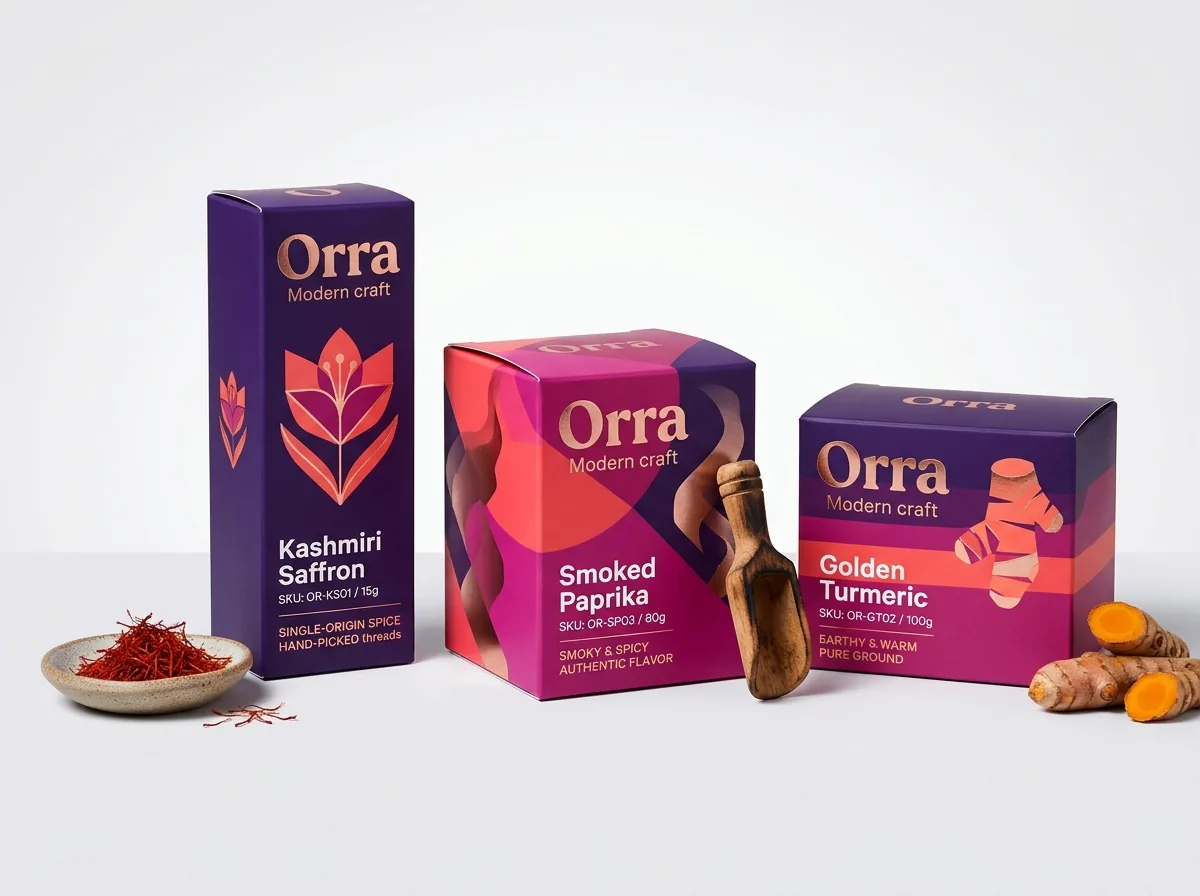
Seasoning brands rely on three very different box architectures depending on what holds the spice inside: a lightweight folding carton built around a heat-sealed foil masala pouch (bag-in-box), a reinforced auto-lock bottom carton for a single glass spice bottle or peppercorn grinder, and an E-flute corrugated mailer or window gift box with internal cell dividers for 3- to 6-jar collections. Bag-in-box cartons weigh very little to ship, block 100% of overhead store light, and stand upright in crowded supermarket aisles where flexible pouches fall flat. Single-jar and multi-jar glass boxes trade higher parcel shipping weight for countertop permanence, luxury gift presentation, and reusable shaker bottles that stay in the customer's kitchen for months. At CubitPack, we manufacture all three custom spice box styles from 1,000 units in 10 to 14 business days with free design help, no die or plate charges, and free shipping to all 50 US states.
How do bag-in-box cartons, single-jar boxes, and multi-jar gift sets compare?
Before locking in your container supply chain, compare how each format behaves on a grocery shelf, on a manual or automated packing bench, and inside a parcel courier truck. A folding carton that works cleanly for a featherweight 50 g foil sachet of garam masala or taco seasoning will buckle at the base if you drop a heavy 4 oz glass jar of coarse sea salt into it. Conversely, using a heavy corrugated box for a single 2 oz herb refill pouch adds unnecessary board cost and shelf width. The comparison table below breaks down the three primary custom printed spice box structures across inner container compatibility, bottom closure strength, outbound freight weight, and retail merchandising impact so you can match each SKU in your catalog to the right structure.
| Feature | Bag-in-box pouch carton | Single glass jar carton | Multi-jar gift box (3–6 jars) |
|---|---|---|---|
| Inner container | 50 g–100 g heat-sealed foil or poly sachet | Single 2 oz, 4 oz, or 8 oz glass bottle / tin | 3, 4, or 6 glass jars or shaker tins |
| Best box style | Straight tuck end or glue-seal end | Auto lock bottom (crash-lock base) | E-flute corrugated mailer or tray & sleeve |
| Board stock | White paperboard or natural kraft card | Heavy paperboard or thin E-flute | E-flute corrugated with card dividers |
| Bottom load capacity | Light (2 oz to 4 oz dry powder weight) | Medium-heavy (8 oz to 14 oz glass + spice) | Heavy (1.5 lb to 4 lb combined glass weight) |
| Window option | Solid panels (hides inner silver foil bag) | Open bottle cutout or patched film window | Multi-pane front windows or solid mailer lid |
| Primary sales channel | Supermarket spice aisles & pantry refills | Specialty grocers, butcher shops & gift shops | DTC e-commerce bundles & holiday gift sets |
Why do masala, curry, and refill spice brands choose bag-in-box cartons?
Walk down any international grocery aisle and you will see rows of rectangular paperboard cartons holding garam masala, kashmiri chili, coriander powder, sumac, and biriyani mixes. Inside each folding carton sits a heat-sealed metallized foil or poly pillow pouch. Pairing an inner barrier sachet with an outer custom straight tuck end box solves two merchandising problems at once: the airtight foil pouch seals in volatile essential oils and blocks kitchen humidity, while the rigid rectangular carton stands upright on narrow wire shelf tracks where standalone flexible pouches tip forward or slump over. Bag-in-box spice cartons also cut both inbound storage space and outbound freight costs compared with glass bottles. Flat-shipped folding cartons and roll-stock foil pouches stack densely on a single pallet, and finished cartons never shatter if dropped by a grocery clerk or parcel courier. After opening the inner sachet at home, cooks either fold the foil bag shut inside the reclosable tuck-top box or pour the refill into a permanent countertop jar.
- Stands upright in supermarket gravity-feed racks and narrow spice aisle shelves without tipping.
- Gives four flat billboards for recipe steps, Scoville heat scales, and multi-language ingredient panels.
- Eliminates glass breakage and cuts parcel shipping weight by more than half compared with glass jars.
- Uses standard straight-tuck or seal-end cartons that run fast on hand benches or automated cartoning lines.
When does a single glass spice jar need an outer folding carton?
Many gourmet spice makers sell 2 oz and 4 oz glass jars naked on local farmers market tables with only a wrap-around label, then discover three headaches when expanding into wholesale grocery distribution and online fulfillment: glass jars clink and chip against each other in master cases, small wrap labels run out of room for nutrition facts and origin stories, and bright store LEDs bleach vibrant red paprika, saffron threads, and green herbs within weeks. Housing each bottle inside a custom auto lock bottom box fixes all three issues at once. The pre-glued crash-lock bottom snaps flat in one second on the packing bench and supports the concentrated deadweight of a glass jar base without pushing open. If you want shoppers to see the whole peppercorns, coarse Himalayan salt crystals, or your front jar label on the shelf, we can die-cut an open rectangular frame on the front panel of the carton while keeping the back and sides enclosed against overhead light. For tall ceramic-mechanism pepper mills and sea salt grinders, adding a die-cut top collar inside the tuck lid keeps the narrower grinder head centered so the bottle never rocks inside the carton.
Know your size? Compare pricing across up to 3 quantities.
Request a Quote →How do corrugated mailers and tray-and-sleeve boxes protect multi-jar gift sets?
Multi-bottle seasoning collections - such as a 3-jar baking spice trio, a 4-bottle BBQ pitmaster dry rub kit, or a 6-jar global curry flight - drive high average order values during Q4 holidays, Father's Day, and housewarming season. However, packing three to six glass jars into one box concentrates two to four pounds of breakable glass inside a compact footprint. For brick-and-mortar gift shops, culinary stores, and butcher counters, a custom tray and sleeve box or a window tuck box with a folded paperboard divider displays all three or four bottles side by side in a neat row. For direct-to-consumer e-commerce orders that travel through parcel sorting hubs, upgrade to an E-flute custom mailer box with an interlocking corrugated cell partition. The 1/16 inch fluted walls absorb corner impacts, the internal divider puts a full corrugated wall between every jar, and the inside of the hinged lid serves as a built-in recipe guide without needing a separate printed booklet.
Cardboard partitions vs foam inserts: which is better for spice bottles?
Both die-cut custom cardboard inserts and foam cavities keep glass spice jars separated, but 90% of culinary brands choose folded paperboard or E-flute corrugated partitions. Cardboard dividers ship flat alongside your flat boxes, fold into place in seconds, cost less per unit than thick foam blocks, and allow your customer to recycle the entire box and insert in one curbside bin. When bottles have a narrow neck and cap (such as hot-sauce-style seasoning dashers or tall peppercorn mills), we pair the bottom cell partition with a die-cut top neck retainer collar that grips each bottle neck so jars never tilt during courier vibration. Reserve die-cut EVA or EPE foam inserts for high-value glass vials - such as gram-weight saffron threads, vanilla bean glass tubes, or ceramic spice mills - where you want a recessed presentation tray inside a luxury rigid gift box. If your spice line sells both everyday grocery refills and seasonal holiday gifts, you do not have to choose only one format. Many growing seasoning brands pair an economical straight-tuck bag-in-box carton for their year-round 100 g supermarket pouches with a seasonal E-flute corrugated 4-jar gift mailer for Q4 online bundles, keeping unified Pantone brand colors across both structures.
What are the most common mistakes when choosing a spice box style?
Matching the wrong box closure or board weight to glass jars leads to bottom blowouts and transit breakage. Avoid these five structural mistakes
- Using a light reverse-tuck bottom for a 4 oz or 8 oz glass spice jar instead of a pre-glued auto-lock bottom.
- Shipping a 3-jar or 6-jar glass spice set in a single-wall paperboard carton without E-flute corrugated protection and cell dividers.
- Putting a front window on a bag-in-box carton where the inner container is an unprinted silver foil pouch.
- Leaving glass bottles free to tilt inside a tall gift box without a top neck-retainer collar or snug lid pad.
- Using loose crinkle paper alone between glass spice jars, which compresses in transit and lets bottles strike each other.
Find your size
Suggested inside size: 1.875 × 1.875 × 3.75 in
A starting point. Your account manager confirms the size with you before the proof.
Quote this size →Packaging for this
Ready to order spice boxes? Compare up to 3 quantities with a free 3D mockup.
Request a Quote →Questions about spice boxes
Can I pack loose ground spices directly inside a folding carton without an inner pouch?
No. Fine ground spices and herbs will sift out through the corner flap gaps of a standard folding carton and lose their aroma quickly to air. Always seal loose spices inside an inner foil sachet, poly bag, tin, or glass jar first.
When should I choose a seal-end carton over a straight-tuck-end carton for spice pouches?
Choose a straight-tuck-end carton when you pack by hand and want customers to reclose the top flap easily. Choose a glue-sealed end carton with a perforated tear strip for high-speed retail lines that need tamper-evident grocery display.
Do open bottle cutouts work without clear plastic window film?
Yes. When your spice sits inside a rigid glass jar or metal shaker tin, an open die-cut window frames the bottle and its front label directly. Skipping the plastic film patch lowers unit cost and keeps the carton all-paperboard.
Can an E-flute corrugated spice gift mailer ship without an outer shipping box?
Yes. An E-flute corrugated mailer with a fitted corrugated cell divider and dust flaps is strong enough to ship directly with a shipping label and tamper seal, or you can slip it inside a poly mailer to keep the exterior print spotless.
What is the minimum order quantity for bag-in-box cartons and spice gift boxes?
Both folding cartons and corrugated spice gift boxes start at 1,000 units at CubitPack, with 10 to 14 business day turnaround (4 to 5 business days rush) and free shipping across all 50 US states.
Can I order matching bottle labels and pouches alongside my spice boxes?
Yes. We produce custom spice jar labels, roll labels, and stand-up pouches so your primary container and outer retail or gift box share exact Pantone color matching.
Still have a question? Ask a packaging specialist.
Request a Quote →Request your spice boxes quote
Tell us your size and quantities, and one dedicated account manager prepares pricing for each tier.
- Free design & AI-to-print studio + 3D mockup
- No die or plate charges · 4–5 day rush available
- Free shipping to all 50 states
- 10% off your first order
This comparison draws on structural testing of straight-tuck, auto-lock bottom, and E-flute mailer cartons across 50 g foil sachets and 4 oz glass spice bottles. A CubitPack packaging specialist checked every specification. See something to update? Tell us and we will fix it.
Sources
What changed
- October 22, 2026: First published.
- October 22, 2026: Updated specifications, terminology, and verified source links.
More guides
New packaging guides by email
Sizes, materials and design tips. Unsubscribe anytime.