
Window tuck vs tray and sleeve tealight boxes: which should you choose?
Short answer: Choose a one-piece window tuck box for everyday 6-pack and 12-pack single-scent tealights where fast hand-loading and lower unit cost matter most. Choose a slide-out tray-and-sleeve box for 4-cup gift strips and 6-scent discovery flights where double-wall crush resistance and drawer unboxing upgrade your custom tealight boxes.
On this page
- How do window tuck, aperture, tray-and-sleeve and stacked tealight boxes compare
- When is a one-piece window tuck box the right choice for tealights
- Why do candle brands choose tray-and-sleeve boxes for sampler flights
- Should I use a clear film window or plastic-free circular die-cut holes
- Which tealight box structure survives e-commerce parcel shipping best
- Common mistakes
- FAQs
Request a custom quoteFree dieline & 3D mockup
The choice between a window tuck carton and a tray-and-sleeve box comes down to whether you are selling a single-scent commodity pack or a multi-scent gift experience. A one-piece straight or reverse tuck carton with a top window (or circular die-cut apertures) folds from a single sheet of paperboard, loads rapidly from one end, and keeps unit cost low for 6-count, 9-count and 12-count retail packs. By contrast, a tray-and-sleeve box combines a folded double-wall drawer with a wrap-around outer sleeve; when a shopper slides the tray out, all four, six or nine tealight cups remain seated upright inside the tray rather than spilling onto the table. That drawer structure makes tray-and-sleeve boxes the clear favorite for reusable multi-scent discovery flights and e-commerce sampler sets. At CubitPack, both styles start at 1,000 units with free design help, no die fees and free US shipping.
How do window tuck, aperture, tray-and-sleeve and stacked tealight boxes compare?
When selecting a structure for custom printed tealight boxes, four folding carton designs handle almost every pack count from a 4-cup spa favor to a 24-cup bulk refill. Use the comparison table below to weigh single-piece economy against drawer presentation and multi-layer density. Notice how the one-piece window tuck box and the plastic-free circular aperture box share the exact same outer folding carton footprint, differing only in how the top panel frames the wax cups. Meanwhile, the tray-and-sleeve structure adds a second paperboard component that doubles side-wall rigidity and lets customers pull out one tealight at a time while storing the remaining cups neatly inside the drawer.
| Tealight box style | Best pack & channel fit | Structure, loading & cost profile |
|---|---|---|
| One-piece window tuck box | 6-pack (2×3) & 12-pack (3×4) retail refills | 1 piece + film window; fast end-loading; economical |
| Circular aperture tuck box | 4-pack & 6-pack beeswax or aromatherapy cups | 1 piece, 100% paperboard; die-cut holes let shoppers smell wax |
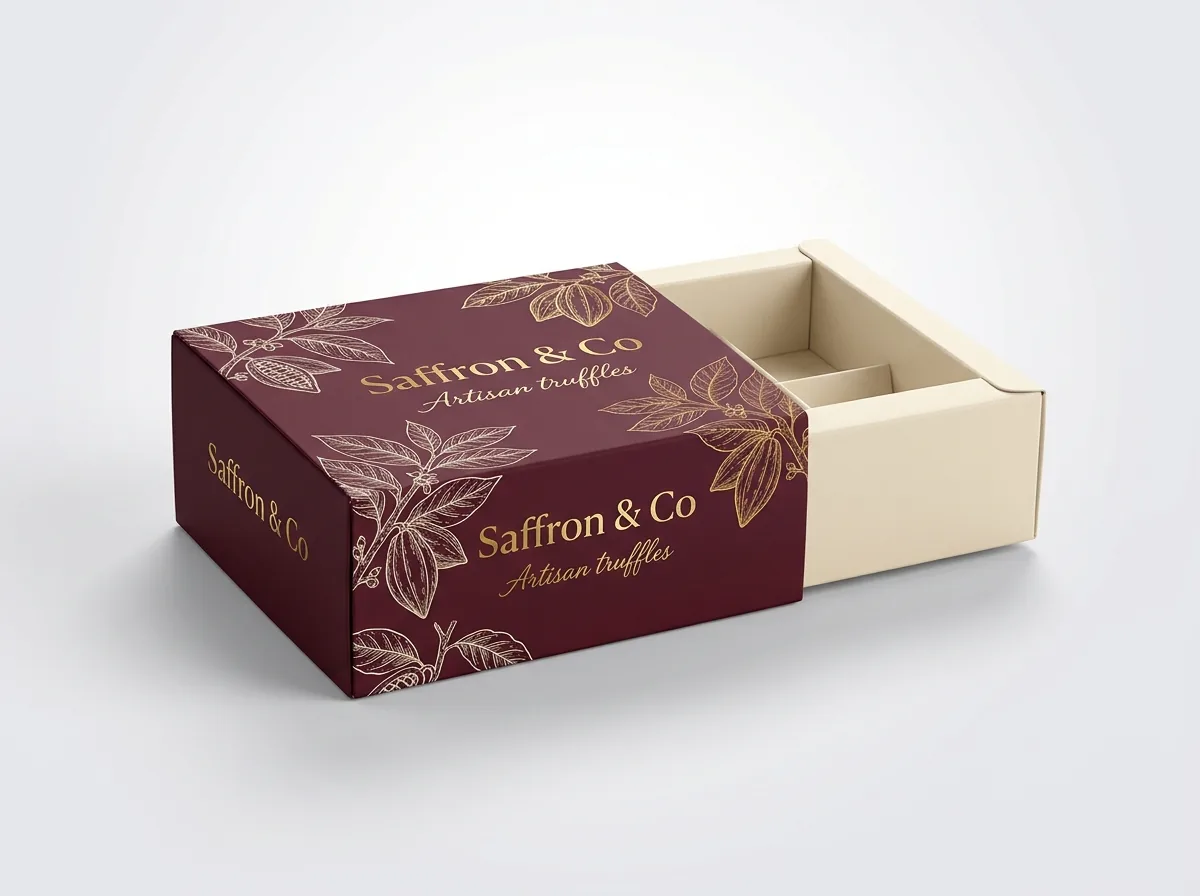
| Slide-out tray and sleeve | 4-cup gift strips & 6-scent discovery flights | 2 pieces (drawer + sleeve); top-loading tray; reusable storage |
| Two-layer straight tuck box | 12-pack (2×6) & 24-pack (2×12) bulk packs | 1 piece + flat card layer pad; compact shelf footprint |
| Two-piece lift-off lid box | 9-pack (3×3) & 12-pack luxury spa assortments | Base tray + telescoping lid + grid insert; boutique unboxing |
| Counter display (PDQ) tray | 12 to 24 slim 4-pack impulse strips | Master carton folds into a checkout counter display tray |
When is a one-piece window tuck box the right choice for tealights?
For single-scent 6-packs, 9-packs and 12-packs sold on boutique tables, grocery shelves or gift shop counters, the one-piece window box with straight tuck end flaps is the industry workhorse. Because the entire carton is die-cut and side-glued from one flat sheet of paperboard, it uses less board area and requires only one gluing pass, keeping your per-box cost as low as possible. A clear top window patch serves two practical jobs on retail shelves: it lets shoppers see pastel soy wax colors, botanical toppings or clear polycarbonate cups at a glance, and it seals the top surface so store dust and fingerprints cannot settle into soft scented wax. When packing a one-piece tuck carton, keep the inside height snug at 0.875 inches so cups slide in smoothly on a flat packing table without tipping over as you tuck the end flap shut.
- Lowest unit cost: single-sheet construction minimizes board waste and gluing steps.
- Dust protection: clear window patching shields soft soy and coconut wax from shop dust.
- Clean front billboard: straight tuck flaps hide raw cut edges on the back and bottom panels.
- Fast flat storage: ships and stores completely flat in thin stacks until packing day.
Why do candle brands choose tray-and-sleeve boxes for sampler flights?
Try sliding six loose tealight cups into the end of a one-piece tuck box when each cup is a different fragrance and needs to land under a specific label - the cups push against each other and spin out of order. A tray and sleeve box solves that packing headache completely because the inner tray is open on top. Your team simply drops each scented tealight straight down into its designated compartment from above, checks that the order matches the printed scent key, and slides the outer sleeve over the tray. Even better, when the customer gets the box home and burns one tealight on Tuesday night, the remaining five cups stay organized inside the rigid double-wall drawer rather than rolling around in an open-ended carton. Adding a slotted cardboard insert inside the tray also keeps strong peppermint or cedarwood scents from mingling with delicate floral cups.
Know your size? Compare pricing across up to 3 quantities.
Request a Quote →Should I use a clear film window or plastic-free circular die-cut holes?
Many beeswax, organic soy and zero-waste home fragrance brands want shoppers to see the golden wax and smell the cold throw without adding a plastic window patch to a recyclable kraft box or paperboard carton. Because CubitPack never charges cutting die fees, you can replace a rectangular film window with an array of circular, hexagonal or arch-shaped die-cut apertures punched directly over each cup. The structural secret to a plastic-free aperture box is diameter control. Standard tealight cups measure 1.5 inches (38 mm) across the rim, so we die-cut each circular opening at 1.3125 to 1.375 inches wide. The 1/8 inch paperboard lip around the perimeter traps the aluminum or plastic cup rim securely inside the carton while leaving the entire wax surface and cotton wick exposed to view and smell. This open-aperture layout works especially well for hard, dust-resistant 100% beeswax tealights sold at farmers markets, apothecaries and natural grocers where plastic-free curbside recyclability is a key selling point.
Which tealight box structure survives e-commerce parcel shipping best?
When shipping tealights directly to online customers or fulfilling monthly candle club subscriptions, thin aluminum cups face crush forces from heavier items in the parcel. A single-layer 3×4 window carton spans 6.375 × 4.75 inches across the top face; if a heavy jar or courier parcel presses down on the center of that wide window span, the lid can flex inward against the cotton wicks. For e-commerce shipping, three structural choices eliminate transit damage. First, a tray and sleeve box with a 6-cell slotted paperboard divider creates internal vertical posts between every cup that support the top sleeve like pillars. Second, a compact two-layer 2×3 straight tuck carton (4.75 × 3.25 × 1.75 inches) with an internal layer pad cuts the unsupported top span in half. Third, for 24-count to 48-count refill packs, upgrading the carton to E-flute corrugated board or a small mailer box gives you crush-resistant fluted walls ready for parcel fulfillment. If you sell through both retail boutiques and your own online store, you do not need to maintain two separate box inventories. Many chandlers use a divided tray-and-sleeve box with circular top apertures in the outer sleeve as an all-channel solution: the internal divider grid braces the sleeve against parcel compression during e-commerce shipping, while the open circular cutouts display the wax colors and let in-person shoppers smell the fragrance flight at markets and gift shops. When packing multi-box wholesale master cases, stack flat tealight cartons horizontally rather than standing them on edge so the aluminum cups rest flat on their bases throughout freight transit.
What are the most common mistakes when choosing a tealight box style?
Picking the wrong carton structure slows down hand-packing and leaves thin metal cups vulnerable to dents. Avoid these five pitfalls
- Using an end-loading tuck carton for a 6-scent sampler with dividers, which makes it impossible to slide cups in from the end.
- Cutting a single giant window across a 12-pack carton with less than 1/4 inch of paperboard border, causing the lid frame to buckle.
- Choosing open die-cut apertures for soft, heavily scented coconut-wax tealights stored in dusty warehouse bins without outer shrink or master cases.
- Ordering a tray-and-sleeve box with zero friction allowance, making the outer sleeve either too tight to slide or loose enough to slip off.
- Packing 24 loose aluminum tealights into a thin folding carton without a center layer pad or E-flute walls for e-commerce shipping.
Find your size
Suggested inside size: 6.25 × 1.625 × 0.875 in
A starting point. Your account manager confirms the size with you before the proof.
Quote this size →Packaging for this
Ready to order tealight boxes? Compare up to 3 quantities with a free 3D mockup.
Request a Quote →Questions about tealight boxes
Is a tray-and-sleeve tealight box more expensive than a window tuck box?
Yes, slightly, because a tray-and-sleeve box uses two separate die-cut pieces (an inner double-wall drawer and an outer wrap sleeve) rather than one flat sheet. However, neither style has cutting die or plate charges at CubitPack, and you can compare both styles on one quote.
Can I combine a slide-out tray with a window on the outer sleeve?
Yes. Many brands pair a divided inner tray with an outer sleeve that has either a clear film window or circular die-cut apertures. That combination gives you fast top-down loading and drawer storage while still showing the wax colors on retail shelves.
Do tray-and-sleeve tealight boxes ship flat or pre-assembled?
Both the outer sleeve and the inner tray ship flat to save storage space and qualify for free ground shipping across all 50 states. The outer sleeve is pre-glued along its seam so it pops open instantly, and the inner tray folds together along pre-scored lines.
What is the minimum order for window tuck or tray-and-sleeve tealight boxes?
Custom printed folding cartons - including window tuck boxes, circular aperture sleeves and tray-and-sleeve sets - start at 1,000 units. If you want a non-collapsible 2 mm rigid drawer or two-piece gift box, our rigid minimum is 50 units.
Which box style works best for a slim 4-pack tealight gift strip?
For a 1×4 strip of four 1.5 inch tealights (6.25 × 1.625 × 0.875 in), a tray-and-sleeve box or a top-opening reverse tuck box with four circular apertures works best. Avoid trying to push four cups single-file down a narrow 1.625 inch end-loading tube without a tray.
Can I see a 3D mockup of both styles before I decide which one to print?
Yes. Tell your account manager whether you want to compare a window tuck carton against a tray-and-sleeve box, and we will prepare free 2D dielines and 3D mockups before you pay. You can also request our $50 sample kit to feel board stocks in person.
Still have a question? Ask a packaging specialist.
Request a Quote →Request your tealight boxes quote
Tell us your size and quantities, and one dedicated account manager prepares pricing for each tier.
- Free design & AI-to-print studio + 3D mockup
- No die or plate charges · 4–5 day rush available
- Free shipping to all 50 states
- 10% off your first order
This comparison was compiled by CubitPack's structural packaging team based on folding carton dieline mechanics, packing-line loading steps and parcel crush performance for 1.5 in and 2.25 in tealight cups. A packaging specialist verified every detail. Spot something wrong? Tell us and we will fix it.
Sources
What changed
- October 22, 2026: First published.
- October 22, 2026: Updated specifications, terminology, and verified source links.
More guides
New packaging guides by email
Sizes, materials and design tips. Unsubscribe anytime.