
What size seed packet box do I need?
Short answer: For standard 3.25 × 4.5 inch seed envelopes, use a 3.5 × 0.375 × 4.75 inch single carton or a 3.5 × 0.75 × 4.75 inch 6-pack box; for 3.5 × 5.0 inch jumbo packets, step up to 3.75 × 0.875 × 5.25 inches. Add 1/8 to 1/4 inch clearance when ordering custom seed packet boxes.
On this page
- How do I measure filled seed envelopes for a folding carton
- What are standard seed packet box dimensions by kit and display type
- How do I size cartons for single foil sachets vs 6-pack and 12-pack gift sets
- What size box fits 24-packet seed libraries, seed bombs, and grow kits
- How do I size a stepped nursery counter display box for 24 to 72 packets
- Common mistakes
- FAQs
Request a custom quoteFree dieline & 3D mockup
Sizing a seed packet box starts with the flat paper envelope inside and the physical loft of the seeds you pack. Most North American vegetable, herb, and flower seed envelopes follow three standard footprints: #3 coin packets (2.5 × 4.25 inches), standard retail packets (3.25 × 4.5 inches), and jumbo pictorial packets (3.5 × 5.0 inches). Adding 1/4 inch to the envelope width and height prevents crisp paper corners from catching on the carton dust flaps during hand loading. To set the front-to-back depth (W), measure a physical stack of filled packets across their thickest center bulge rather than measuring empty paper sleeves. A 6-pack of 3.5 × 5.0 inch herb packets fits a 3.75 × 0.875 × 5.25 inch box, while a 12-pack vegetable collection fits 3.75 × 1.625 × 5.25 inches. Every order of printed seed packet boxes at CubitPack is cut to your exact inside dimensions with no die fees.
How do I measure filled seed envelopes for a folding carton?
The biggest surprise when sizing a multi-packet seed box is 'packet belly', the natural center bulge created when seeds settle into the bottom third of a paper envelope. Six empty paper seed packets stack to less than 1/16 inch thick, but once filled with sweet corn, bush beans, sugar snap peas, nasturtiums, or sunflower seeds, those same six envelopes can swell to 0.75 or 1.0 inch thick in the middle while staying paper-thin at the top and bottom edges. Always assemble a real sample stack of the exact varieties going into your kit, alternate every other packet upside down if you want to level out the bulge, and measure the uncompressed thickness at the center with calipers or a ruler. Add 1/4 inch (0.25 in) to your flat packet width and height so the envelopes slide past the side glue seam and dust flaps without dog-earing. When you request a quote for custom seed collection boxes, enter those inside dimensions as Length (L) × Width (W) × Height (H) in inches.
- Measure flat envelope width (left to right) and add 1/4 inch to set the carton's inside Length (L).
- Measure flat envelope height (top to bottom) and add 1/4 inch to set the carton's inside Height (H).
- Stack your actual filled seed packets in the order they will be packed and measure the center bulge without squeezing.
- Add 1/8 inch to that uncompressed stack thickness to set the carton's inside Width / depth (W).
- If your kit mixes fine seeds (basil, carrot, poppy) with bulky seeds (peas, beans, squash), size for the bulkiest assortment so all kits share one dieline.
What are standard seed packet box dimensions by kit and display type?
Although CubitPack cuts every custom dieline to order with zero die or plate charges, most seed companies, museum shops, and garden centers build their line around three US envelope standards (#3 coin, 3.25 × 4.5 in standard, and 3.5 × 5.0 in jumbo). Use the reference chart below to benchmark your inside carton dimensions before testing your own filled packets. Notice how the orientation changes once you pass 12 packets. Up to 12 envelopes, packets usually lie face-forward in a slim vertical tuck box or slide-out drawer sleeve. For 20 to 30 packets, or for retail counter displays holding 24 to 60 packets, the envelopes turn perpendicular so gardeners can flip through the top headers like recipe index cards.
| Seed packet format or kit | Typical inside box size (L × W × H) | Recommended box style |
|---|---|---|
| Single #3 coin packet (2.5 × 4.25 in) or mini favor | 2.75 × 0.375 × 4.5 in | Straight tuck end, hang tab |
| Single standard seed packet (3.25 × 4.5 in) or foil sachet | 3.5 × 0.375 × 4.75 in | Straight tuck end, window |
| 6-pack standard seed packets (3.25 × 4.5 in) | 3.5 × 0.75 × 4.75 in | Straight tuck end or window box |
| 6-pack jumbo pictorial seed packets (3.5 × 5.0 in) | 3.75 × 0.875 × 5.25 in | Straight tuck end, window |
| 12-pack vegetable or salsa garden set (3.5 × 5.0 in) | 3.75 × 1.625 × 5.25 in | Tray and sleeve or tuck end |
| 9 clay wildflower seed bombs (3 × 3 grid) | 3.75 × 3.75 × 1.25 in | Tray and sleeve with divider grid |
| 24-packet heirloom seed vault (with index tabs) | 5.25 × 4.0 × 3.75 in | Two-piece or corrugated tuck vault |
| Windowsill grow kit (seeds, coir discs, 3.5 in pot) | 4.25 × 4.25 × 4.5 in | Auto-lock bottom with insert |
| 48-packet 2-tier nursery counter display (4 pockets) | 7.75 × 5.5 × 5.25 in (base) | Counter display box with riser |
How do I size cartons for single foil sachets vs 6-pack and 12-pack gift sets?
When packaging rare pelleted flower seeds, hydroponic pod refills, or medicinal herbs sealed inside a moisture-barrier foil pouch, an outer paperboard straight tuck end box measuring 3.5 × 0.375 × 4.75 inches gives the flexible inner sachet a rigid retail spine. That 0.375 inch (3/8 in) depth is thick enough to stand in slotted display racks and wide enough on the back panel to print complete germination tables and USDA hardiness zone maps. For curated 5-pack or 6-pack themed sets, like a Kitchen Herb Trio, Cut-Flower Bouquet Mix, or Pollinator Meadow starter, a 3.5 × 0.75 × 4.75 inch carton (for 3.25 × 4.5 in envelopes) or a 3.75 × 0.875 × 5.25 inch carton (for 3.5 × 5.0 in envelopes) is the gold standard. Stepping up to a 10-pack or 12-pack seasonal vegetable assortment doubles the depth to 1.5 or 1.625 inches, which pairs beautifully with a slide-out tray and sleeve box or a custom window box that frames the top packet's botanical artwork.
Know your size? Compare pricing across up to 3 quantities.
Request a Quote →What size box fits 24-packet seed libraries, seed bombs, and grow kits?
Beyond flat envelope bundles, three specialty seed formats require dedicated interior dimensions: index-style seed libraries, clay wildflower seed balls, and all-in-one windowsill grow kits. For a 20-to-24 packet heirloom seed library or preparedness vault, stacking envelopes flat creates a slippery pile. Instead, orient 3.5 × 5.0 inch packets horizontally on their 5.0 inch edge inside a 5.25 × 4.0 × 3.75 inch box with printed seasonal tab dividers (Spring, Summer, Fall) so gardeners can flip through varieties like a recipe box. For clay and compost wildflower seed bombs measuring 1.0 inch in diameter, a shallow 3.75 × 3.75 × 1.25 inch square box fitted with a 3 × 3 interlocking custom cardboard insert cradles nine spheres in separate 1.125 inch cells so they never knock together and crumble. If you are bundling seed packets with compressed 36 mm coco coir soil wafers and a 3.5 inch molded fiber pot, or shipping potted starts alongside our custom plant boxes, use a 4.25 × 4.25 × 4.5 inch auto-lock bottom box with a die-cut collar.
How do I size a stepped nursery counter display box for 24 to 72 packets?
When garden centers, bookstores, and farm stands place seed packets next to the register, a plain open tray fails as soon as the first ten envelopes sell: the remaining thin packets slide forward and lie flat where shoppers cannot read the titles. Properly sizing a counter display box solves that with narrow pocket widths and shallow front-to-back pocket depths. For a single-column checkout caddy holding 25 to 30 jumbo 3.5 × 5.0 inch seed packets, size the inside pocket to 3.75 inches wide by 4.5 inches deep with a sloped false bottom that tilts the stack back 10 degrees. For a 48-to-60 packet 2-tier, 4-pocket display (two pockets across by two stepped tiers deep), size the base to 7.75 × 5.5 × 5.25 inches. Each individual pocket measures 3.75 inches wide by 2.5 inches deep, and the rear tier sits 1.75 inches higher on an internal paperboard riser so the back row of botanical headers stands clearly above the front row.
- Single-pocket counter caddy (25–30 packets): 3.75 × 4.5 × 5.0 in base + 4.0 in header.
- Side-by-side 2-pocket display (30–40 packets): 7.75 × 3.0 × 5.0 in base + 4.0 in header.
- Stepped 2-tier, 4-pocket nursery display (48–60 packets): 7.75 × 5.5 × 5.25 in base + 4.5 in header.
- Stepped 3-tier, 6-pocket display (72–90 packets): 11.5 × 7.5 × 5.5 in base + 5.0 in header.
What are the most common seed packet box sizing mistakes?
Paper envelopes and organic seeds behave differently from rigid bottles or jars. Check these five sizing errors before approving your dieline proof
- Measuring the thickness of empty paper envelopes instead of filled seed packets, leaving no room for the center 'packet belly' of pea, bean, corn, or sunflower seeds.
- Cutting the carton to the exact 3.25 × 4.5 in or 3.5 × 5.0 in packet size with zero clearance, which bends and tears envelope corners against the dust flaps.
- Building a counter display pocket deeper than 2.75 inches front-to-back without an angled riser, allowing thin seed packets to slump flat once half the pocket sells.
- Making a front die-cut window wider than 2.75 inches on a 3.5 inch seed box, which lets the top packet slip sideways and show raw interior board.
- Packing loose clay wildflower seed balls into a box without a cell divider grid, causing clay dust and broken spheres during parcel shipping.
Find your size
Suggested inside size: 3.5 × 0.375 × 4.75 in
A starting point. Your account manager confirms the size with you before the proof.
Quote this size →Packaging for this
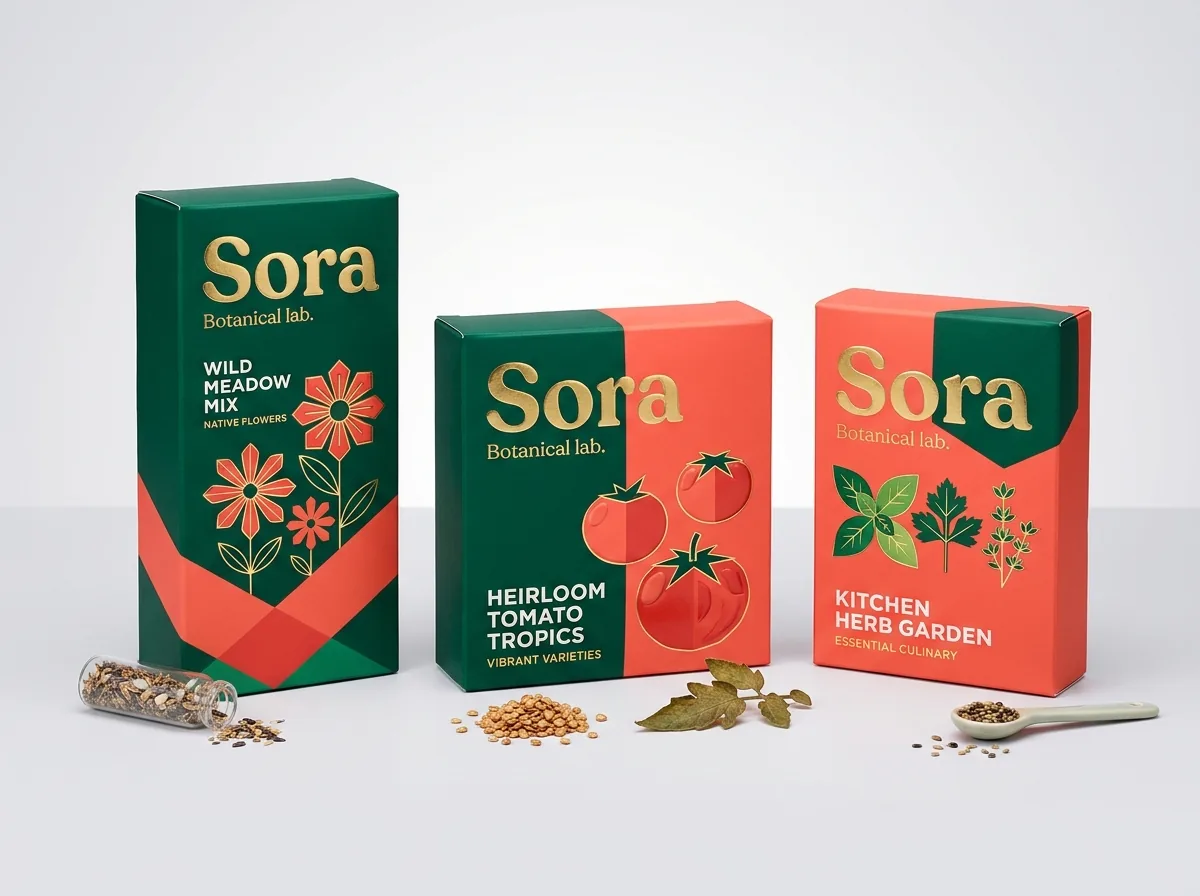
Ready to order seed packet boxes? Compare up to 3 quantities with a free 3D mockup.
Request a Quote →Questions about seed packet boxes
What are the standard dimensions of a US retail seed packet?
The two most common US retail seed envelope sizes are 3.25 × 4.5 inches (standard vegetable and herb size) and 3.5 × 5.0 inches (jumbo pictorial flower and heirloom size). Smaller favor and sample envelopes typically use the #3 coin size at 2.5 × 4.25 inches.
How much clearance should I add around my seed packets when sizing a box?
Add 1/4 inch (0.25 in) to both the width and height of your flat seed envelope so paper edges slide past the carton's side glue seam and top dust flaps without catching. Add 1/8 inch to the uncompressed center thickness of your filled packet stack.
What size box holds a 6-pack vs a 12-pack of 3.5 × 5.0 inch seed packets?
For 3.5 × 5.0 inch seed envelopes, a 6-pack collection typically uses an inside carton dimension of 3.75 × 0.875 × 5.25 inches, and a 12-pack collection uses 3.75 × 1.625 × 5.25 inches. If your assortment includes bulky bean or corn seeds, add an extra 1/8 inch of depth.
Can I use one box size for multiple themed seed collections?
Yes. By sizing your master dieline to fit your thickest 6-pack or 10-pack assortment, you can gang-run your Herb Garden, Salad Greens, Cut Flower, and Pollinator kits in a single order with zero die or plate charges.
How deep should each pocket be in a seed packet counter display box?
Keep each divided pocket in a retail counter display between 2.0 and 2.5 inches deep from front to back, holding roughly 12 to 15 packets per pocket. Shallower pockets keep thin envelopes standing upright at a clean backward angle.
Can I test my seed packet stack inside a dieline before paying?
Yes. Every CubitPack order includes a free 2D dieline proof and interactive 3D mockup before payment. You can print the flat dieline at 100% scale to test your physical stack of filled seed packets, or order a custom printed sample.
Still have a question? Ask a packaging specialist.
Request a Quote →Request your seed packet boxes quote
Tell us your size and quantities, and one dedicated account manager prepares pricing for each tier.
- Free design & AI-to-print studio + 3D mockup
- No die or plate charges · 4–5 day rush available
- Free shipping to all 50 states
- 10% off your first order
The inside dimensions in this guide were calculated from standard US #3 coin (2.5 × 4.25 in), retail (3.25 × 4.5 in), and jumbo (3.5 × 5.0 in) seed envelopes across fine-seed and large-seed loft thicknesses, adding 1/8 to 1/4 inch folding clearance. Checked by a CubitPack packaging specialist. Spot something wrong? Tell us and we will fix it.
Sources
What changed
- October 22, 2026: First published.
- October 22, 2026: Updated specifications, terminology, and verified source links.
More guides
New packaging guides by email
Sizes, materials and design tips. Unsubscribe anytime.