
What size box fits 4-pan, 6-pan, 12-pan and 35-pan makeup palettes?
Short answer: A 4-pan face quad usually fits a 4.25 × 4.25 × 0.625 inch box, a 6-pan contour and blush palette takes around 5.75 × 3.75 × 0.625 inches, and a 12-pan rectangular palette fits 6.5 × 4.25 × 0.75 inches. Measure your palette with calipers and order custom makeup palette boxes to fit.
On this page
- How do I measure an assembled makeup palette for an outer carton or sleeve
- What are the standard makeup palette box dimensions by pan count
- How do I calculate custom rigid book palette dimensions from pan sizes
- How much thickness do internal mirrors, acetate shields and brushes add
- When should I expand the box size to fit a corrugated drop buffer
- Common mistakes
- FAQs
Request a custom quoteFree dieline & 3D mockup
Sizing a makeup palette box depends on whether you are building the primary magnetic book case around bare metal pans or sizing the secondary outer unit carton and slipcase around an already-assembled palette. When sizing an outer folding carton or open-end sleeve, measure the closed palette's outer length, width and spine thickness with digital calipers, then add 1/16 inch (0.0625 in) to the spine thickness and 1/16 to 1/8 inch to length and width so soft-touch lamination never binds during sliding. When designing a custom rigid magnetic book palette from scratch, multiply the metal pan diameter (such as 26 mm, 36 mm or 57 mm) by the number of columns and rows, add 6 to 8 mm of paperboard bridge between pans, and add 12 to 15 mm of outer perimeter frame around the deck to house the hidden flap magnets.
How do I measure an assembled makeup palette for an outer carton or sleeve?
Whether your primary palette is an injection-molded acrylic case or a wrapped rigid magnetic book, small structural details change its true outer footprint. On a rigid book-style palette, the wrapped chipboard (gray board) cover often overhangs the inner pan deck by 1/16 inch on three sides, and the hinged spine can crown slightly thicker than the magnetic fore-edge. On a molded plastic palette, the rear hinge barrel and front clasp lip protrude past the main frame. Folding cartons and sleeves are always quoted by inside dimensions written as Length × Width × Height (L × W × H). For a wide rectangular palette, set the long horizontal cover dimension as Length, the thin spine depth as Width, and the vertical cover height as Height (or orient the tuck flaps on the narrow ends so the wide cover panels stay uninterrupted). When you quote printed makeup palette cartons, our prepress team verifies your caliper numbers and builds a 3D mockup before payment.
- Measure total palette length and width across the outermost cover edges or hinge knuckles.
- Measure thickness at both the spine and the front clasp when the palette is closed with its brush or mirror inside.
- For a 6-sided straight tuck carton, add 1/16 in to width and depth and 1/8 in to the tuck-flap axis.
- For an open-end slipcase sleeve, add exactly 1/16 in (1.5 mm) to spine thickness and vertical height for smooth sliding.
- If adding an internal E-flute corrugated shock sleeve for large palettes, add 3/16 in to all three inside dimensions.
What are the standard makeup palette box dimensions by pan count?
Because CubitPack cuts every order to your exact dieline with zero die or plate charges, you can build around any custom pan arrangement, from a long narrow 5-pan contour bar to an octagonal holiday vault. Still, most face, cheek, lip and artistry palettes cluster around seven classic footprints. Use the reference table below to benchmark your palette size before measuring your physical sample. Notice how face palettes (which use wider 36 mm to 59 mm blush, bronzer and highlighter pans) have larger footprints per pan than eye or lip palettes (which typically use 20 mm to 26 mm pans). Every dimension listed in the chart represents the usable inside space of the outer folding carton or slipcase sleeve.
| Palette format & pan count | Typical inside box size (L × W × H) | Recommended box or sleeve style |
|---|---|---|
| 4-pan face contour quad (2×2 grid, 36-44 mm pans) | 4.25 × 4.25 × 0.625 in | Straight tuck end or open-end sleeve |
| 9-pan compact square grid (3×3 grid, 26 mm pans) | 4.0 × 4.0 × 0.625 in | Straight tuck end or window carton |
| 6-pan sculpting bronzer, blush & glow deck (2×3) | 5.75 × 3.75 × 0.625 in | Straight tuck end or slipcase sleeve |
| Empty magnetic refillable z-palette with window | 6.0 × 4.0 × 0.625 in | Magnetic book rigid + outer paperboard sleeve |
| 12-pan rectangular palette with mirror & brush well | 6.5 × 4.25 × 0.75 in | Straight tuck end + inner card or flute liner |
| 18-to-24 pan artistry lookbook palette | 8.0 × 5.5 × 0.75 in | Magnetic book rigid + straight tuck outer carton |
| 30-to-35 pan pro makeup artist master vault | 9.5 × 6.75 × 0.875 in | Straight tuck carton + E-flute corrugated mailer |
How do I calculate custom rigid book palette dimensions from pan sizes?
If you are engineering a custom wrapped rigid magnetic book palette from the ground up (starting at 50 units), your outer dimensions are driven by the metal pans inside. Standard round or square aluminum cosmetic pans come in 26 mm (1.02 in) for eye and lip colors, 36 mm (1.42 in) for cheek and highlighter trios, and 44 mm to 59 mm (1.73 to 2.32 in) for bronzers and setting powders. To calculate the width and height of the inner die-cut pan deck, sum the pan widths in each row and add 6 mm to 8 mm (about 1/4 inch) of paperboard bridge between adjacent pans so the die-cut web stays flat and leaves room for printed shade names beneath each well. Next, add a 12 mm to 15 mm (about 1/2 inch) perimeter rim around all four edges of the deck to house the concealed neodymium closure magnets and support the lid when closed. Pair your rigid book with precision custom cardboard inserts or custom EVA foam inserts to lock every pan flush.
Know your size? Compare pricing across up to 3 quantities.
Request a Quote →How much thickness do internal mirrors, acetate shields and brushes add?
Founders often calculate palette length and width accurately from the pan grid but underestimate the closed spine thickness (Height or Width). A bare magnetic pan deck with a flat cardboard cover can be as slim as 0.45 to 0.5 inches thick. However, adding a 1.5 mm glass vanity mirror inside the top lid, a clear PET acetate dust sheet over the pans, and a recessed well for a dual-ended contour brush increases the spine thickness to 0.75 or 0.875 inches. If you also include domed baked highlighter pans alongside flat matte contour pans in the same face palette, size the well depth and spine height to clear the tallest baked dome by at least 2 mm so the clear dust shield and mirror never press down on the powder peak. If you sell individual cheek pans alongside your multi-pan palettes, see our custom blush boxes and custom eyeshadow boxes for single-pan and quad dimensions.
When should I expand the box size to fit a corrugated drop buffer?
Once a makeup palette exceeds 6 inches in length (such as an 18-pan artistry book or a 35-pan pro vault), the wide flat surface acts like a lever during parcel transit. If a heavy box lands on one corner of the palette in a sorting bin, diagonal torsional flex can pop pressed cakes out of their glue wells or crack the internal glass mirror across the middle. For any palette 6.5 inches or wider that ships direct-to-consumer, we recommend adding a wrap-around E-flute corrugated inner buffer inside your printed retail carton, or packing the retail carton inside a custom-fitted custom mailer box. Add 3/16 inch to your outer carton's length, width and height whenever you include an inner corrugated buffer pad.
- Palettes under 5 inches (quads & 6-pan compacts): a snug folding paperboard carton or sleeve is sufficient for retail.
- Palettes 6 to 8 inches wide with glass mirrors: add an internal folded card frame or E-flute buffer pad (+3/16 in).
- Large 24-to-35 pan pro palettes: ship in a custom E-flute mailer box or foam-lined rigid collector case.
- Order a physical prototype or paid printed sample (credited to your order) to drop-test your filled palette before production.
What are the most common makeup palette box sizing mistakes?
Wide flat palettes have tight sliding tolerances and fragile mirrors. Avoid these five sizing errors before approving your structural dieline
- Cutting an open-end slipcase sleeve to the exact spine thickness of a soft-touch book palette with zero clearance, causing the sleeve to jam halfway on.
- Measuring the inner pan deck of a rigid book palette and forgetting the 1/16 inch outer cover overhang around the three open edges.
- Placing pan wells only 2 mm apart on a custom deck, which leaves the die-cut paperboard web too weak to stay flat and leaves no room for shade names.
- Forgetting to add spine depth for a 1.5 mm glass mirror, clear acetate dust sheet or dual-ended brush cavity.
- Shipping wide 18-to-35 pan palettes in a thin carton with no corrugated buffer allowance, leading to cracked mirrors in e-commerce transit.
Find your size
Suggested inside size: 4.25 × 4.25 × 0.625 in
A starting point. Your account manager confirms the size with you before the proof.
Quote this size →Packaging for this
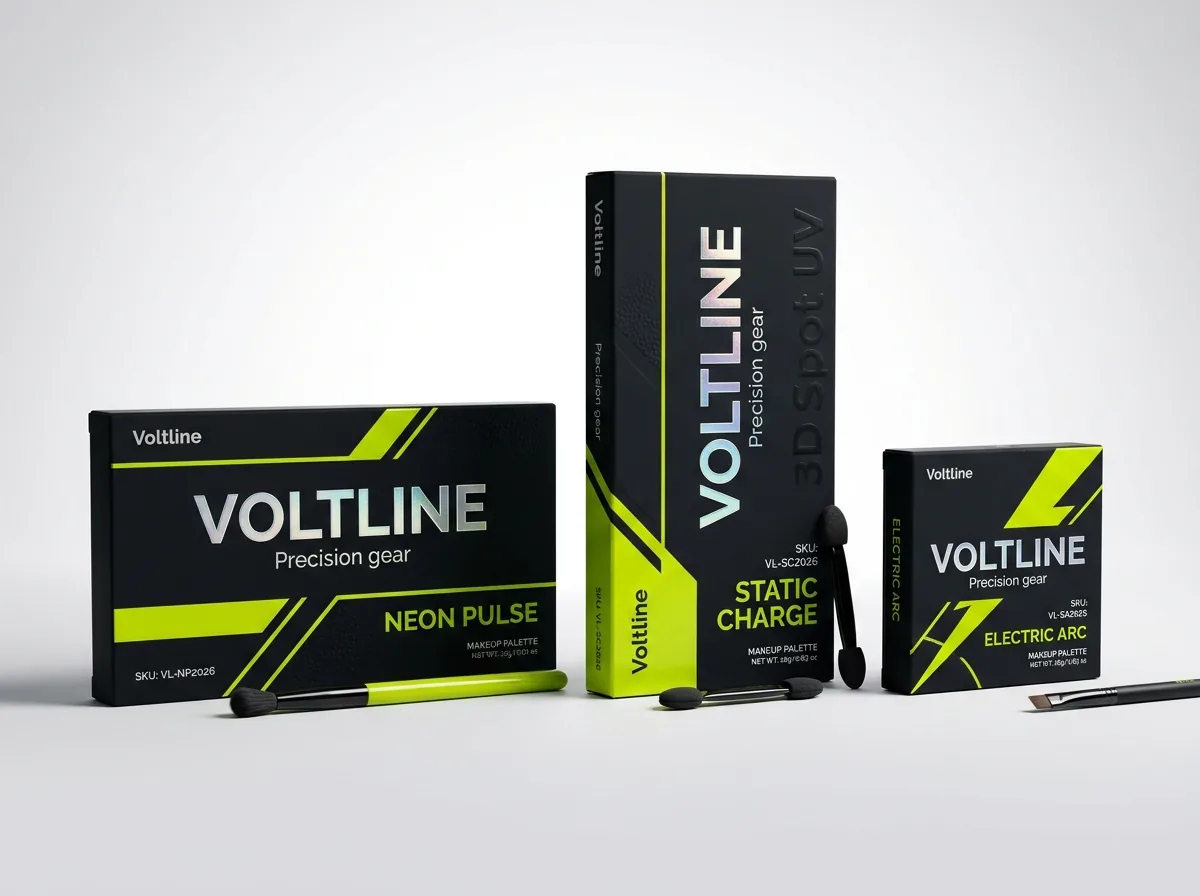

Ready to order makeup palette boxes? Compare up to 3 quantities with a free 3D mockup.
Request a Quote →Questions about makeup palette boxes
Are makeup palette boxes and sleeves quoted by inside or outside dimensions?
All CubitPack folding cartons, open-end slipcases and rigid book palettes are specified by inside dimensions: length × width × height in inches. Quoting by inside dimensions ensures your finished palette slides into its outer carton or sleeve without catching on the board thickness.
How much clearance should I add for an open-end palette slipcase sleeve?
Add 1/16 inch (about 1.5 mm) to both the vertical height and the spine thickness of your closed palette. That gives the sleeve enough friction to stay on when picked up on a retail shelf while sliding off smoothly without tearing.
Should the tuck flaps of a rectangular palette box go on the long side or the short end?
Putting the tuck flaps on the shorter ends (so the palette slides in lengthwise) keeps the long front and back cover edges stronger and prevents wide flaps from bowing open. For square 4-pan quads, top-and-bottom tuck flaps are standard.
Can you make a custom insert that holds both round blush pans and rectangular bronzer pans?
Yes. Because we charge zero die or plate fees, our CAD team can die-cut paperboard or EVA foam pan decks with any combination of round, square, rectangular or custom geometric pan cutouts on the same tray.
What size box fits a makeup palette plus a separate setting spray or brush?
A face palette bundled with a full-size cheek brush or setting mist typically fits a two-piece or magnetic rigid box around 7.5 × 5.5 × 1.75 inches with a custom multi-cavity EVA foam or folded paperboard insert.
Can I test my palette box and pan deck dimensions before running 1,000 units?
Yes. Every order includes a free 2D digital dieline proof and 3D mockup before payment. You can also order a physical prototype or paid printed sample (credited toward your production order) to test pan fit and drop safety in hand.
Still have a question? Ask a packaging specialist.
Request a Quote →Request your makeup palette boxes quote
Tell us your size and quantities, and one dedicated account manager prepares pricing for each tier.
- Free design & AI-to-print studio + 3D mockup
- No die or plate charges · 4–5 day rush available
- Free shipping to all 50 states
- 10% off your first order
The palette dimensions, pan-grid bridge rules and slipcase clearances in this guide are based on standard cosmetic metal pan molds and folding carton engineering conventions, checked by a CubitPack packaging specialist. Spot something wrong? Tell us and we will fix it.
Sources
What changed
- October 22, 2026: First published.
- October 22, 2026: Updated specifications, terminology, and verified source links.
More guides
New packaging guides by email
Sizes, materials and design tips. Unsubscribe anytime.