
How do I size custom drawer boxes with a window, sleeve margins, and tray depth?
Short answer: Always specify custom drawer boxes with window by the usable inside length, width, and height of the pull-out tray in inches, add 1/16 to 1/8 inch of vertical headspace below the patched window film, and keep a minimum 0.5-inch (12 to 15 mm) solid board frame around the cutout.

On this page
- How do inside drawer tray dimensions relate to outer window sleeve dimensions
- What are the six most practical window drawer box sizes for jewelry, sweets, beauty, and gifts
- How wide should the sleeve border around the window cutout be so the box stays rigid
- How do horizontal glide clearance, ribbon knots, and foam inserts change tray sizing
- How can I verify my custom window drawer dimensions before production starts
- Common mistakes
- FAQs
Request a custom quoteFree dieline & 3D mockup
Sizing a sliding drawer box with a clear viewing window involves three linked measurements that single-piece tuck cartons never face: the usable interior cavity of the inner drawer tray, the sliding glide gap between the tray walls and the outer wrap sleeve, and the structural bridge width framing the die-cut window on top. If the tray depth is 2 mm too shallow, taller chocolate domes or dropper caps rub directly against the clear adhesive film patch whenever the drawer slides open. If the window frame is narrower than 0.5 inches on compact boxes or 0.75 inches on wide rigid gift sets, the outer sleeve bows outward and loses friction grip. At CubitPack, rigid wrapped window drawers start at 50 units (folding sleeves from 1,000), ship in 10 to 14 business days with 4 to 5 day rush quoted, and include a free custom dieline, 3D mockup before payment, and free US shipping.
How do inside drawer tray dimensions relate to outer window sleeve dimensions?
When requesting a quote for slide-out window drawer packaging, you only need to supply the usable interior Length (L) × Width (W) × Height (H) of the inner drawer tray. You can test product clearances in our box size calculator or inspect flat layouts in our tray and sleeve dieline templates. From your inside tray dimensions, our structural specialists add board wall thickness, paper wrap turn-ins, and horizontal/vertical glide tolerances automatically
- Length (L) runs along the pull axis or longest base edge: Measure the longest footprint edge of your product or multi-item EVA foam layout, adding 1/16 in (1.5 mm) around rigid plastic blister trays or 0.5 in around outer foam perimeters.
- Width (W) spans across the sleeve opening: On a closed-back rigid drawer box with a satin ribbon pull, the drawer slides out along one axis while the side walls of the tray bear against the inner walls of the sleeve.
- Height / Tray Depth (H) sets vertical clearance under the window: Measure your tallest item standing in its insert, then add 1.5 to 3.0 mm (1/16 to 1/8 in) of vertical air gap so glossy chocolate shells, foil labels, or glass droppers never scuff the inner window film.
- Double-wall folded trays vs wrapped rigid gray board trays: Folding paperboard drawers often use roll-over side walls (adding 6 to 10 mm per side to the outer footprint) to create clean hollow rims, whereas wrapped rigid drawers use solid vertical chipboard walls.
What are the six most practical window drawer box sizes for jewelry, sweets, beauty, and gifts?
Because CubitPack charges zero cutting die fees, you never have to force a 3-piece serum kit into an oversized stock shell. Compare these six production-proven interior drawer dimensions across custom drawer boxes and custom tray and sleeve boxes as starting benchmarks
| Product category | Usable inner tray (L × W × H) | Recommended window aperture | Min. sleeve border & structure |
|---|---|---|---|
| Fine jewelry pendant or earrings | 3.5 × 3.5 × 1.25 in | 2.25 × 2.25 in square or bevel | 0.625 in border · Rigid wrapped (from 50) |
| False eyelashes or twin lip duo | 5.0 × 2.25 × 0.75 in | 3.75 × 1.25 in rounded pill | 0.50 in border · Folding card (from 1,000) or rigid |
| 6-count French macaron baton | 7.25 × 2.25 × 2.0 in | 5.75 × 1.125 in panoramic strip | 0.56 in side rail · Folding sleeve or rigid |
| 16-piece chocolate bonbon grid | 6.5 × 6.5 × 1.5 in | 5.0 × 5.0 in square window | 0.75 in border · Rigid or double-wall card |
| 3-piece 30 ml skincare dropper kit | 8.5 × 5.5 × 2.25 in | 6.75 × 3.75 in arch or rectangle | 0.875 in border · Rigid with EVA foam |
| Corporate holiday or VIP PR box | 10.5 × 8.0 × 3.25 in | 8.5 × 6.0 in framed window | 1.00 in border · Heavy rigid with ribbon pull |

How wide should the sleeve border around the window cutout be so the box stays rigid?
Cutting a viewing aperture removes central tension from the top panel of the outer sleeve. Every time a customer pulls the ribbon tab or pushes the thumb notch, narrow side rails flex outward unless the frame has enough caliper and width. You can compare rigid and paperboard thicknesses in our paperboard thickness converter and follow three structural border rules
- Minimum 0.50 inch (12.7 mm) border on compact boxes under 6 inches wide: A half-inch frame gives automated patching equipment at least 8 to 10 mm of hidden interior glue strip around all four sides of the clear film sheet without glue squeezing into view.
- Step up to 0.75–1.00 inch (19–25 mm) borders on medium and large rigid gift drawers: Once a sleeve spans 7 to 11 inches across, wider solid borders keep the top bridge dead-flat across custom rigid boxes with window and prevent corner wrinkling on soft-touch wraps.
- Round interior window corners to at least a 2 to 4 mm radius: Sharp 90-degree die-cut corners concentrate tearing stress on folding paperboard sleeves when packed rapid-fire on fulfillment lines; subtle corner radii distribute pull tension cleanly.
- Keep foil stamping and blind debossing at least 3 mm outside the cut edge: Metallic foil dies apply heat and pressure; leaving a 3 mm safety buffer from the die-cut window edge prevents board crushing along the bevel.

Know your size? Compare pricing across up to 3 quantities.
Request a Quote →How do horizontal glide clearance, ribbon knots, and foam inserts change tray sizing?
A luxury drawer box should glide open with gentle one-hand resistance, neither falling out when tilted at 30 degrees nor sticking halfway inside the shell. Pairing your box with custom EVA foam inserts or custom cardboard inserts requires accounting for three hidden thickness allowances
- Calibrated sleeve-to-drawer glide gap (typically 1.0 to 2.0 mm total across width and height): Smooth gloss or matte film wraps slide with slightly less friction than uncoated textured kraft or velvety soft-touch lamination, so our dielines tune clearance to your exact wrap finish.
- Recessing ribbon pull knots or flat-taped ribbon ends: On closed-back rigid drawers, a satin ribbon tab threads through a horizontal slot in the front tray wall and anchors flat beneath the inner liner paper so no knot lump scrapes the sleeve.
- Stepping insert height 2 to 3 mm below the top rim of the drawer wall: Keeping EVA foam or folded card dividers slightly recessed inside the tray prevents the top edge of the insert from snagging the glued edge of the window film patch.
- Checking parcel overbox dimensional weight: If you mail heavy rigid gift drawers directly via UPS or FedEx, run your outer corrugated shipper dimensions through our dimensional weight calculator before locking tray height.
How can I verify my custom window drawer dimensions before production starts?
Whether you need 50 rigid wrapped window drawers for a seasonal jewelry drop or 2,500 folding window sleeves for retail confectionery, CubitPack verifies every millimeter before a single sheet goes on press. You can also compare structural setups in our companion guide on rigid window drawers vs folding window sleeves and lid boxes and review adhesive window clearances in clear film patching and insert alignment on slide drawer boxes
- Free custom dieline and 3D mockup before payment: Send your product measurements or ship an empty blister tray to our team; you receive a 2D vector dieline and an interactive 3D mockup showing exact window framing before paying.
- Sample kit and physical prototypes: Order our $50 sample kit (credited toward your first order) to feel wrap finishes and board calipers, or request a paid custom prototype built to your exact tray and window dimensions.
- Fast 10–14 business day turnaround and Price Beat policy: Standard runs finish in 10 to 14 business days (4 to 5 business day rush quoted per order) with free 50-state US shipping and our Price Beat policy on written US competitor quotes.
What are the five costliest sizing mistakes on custom drawer boxes with windows?
Double-check these five measurement traps before signing off on your 2D dieline proof
- Sending outside box guesses instead of the usable inside length, width, and height of the inner sliding tray.
- Designing a top window border narrower than 0.5 inches, leaving weak side bridges that bow outward and let the film patch lift.
- Setting tray depth equal to exact product height with zero headspace, causing bottle caps or chocolate tops to drag across the clear window film.
- Placing EVA foam or card divider cavity walls inside the window viewing zone instead of tucking insert perimeters under the solid sleeve border.
- Measuring the bottom cups of a plastic candy blister tray while forgetting the wider top rim flange that rests against the drawer walls.
Packaging for this


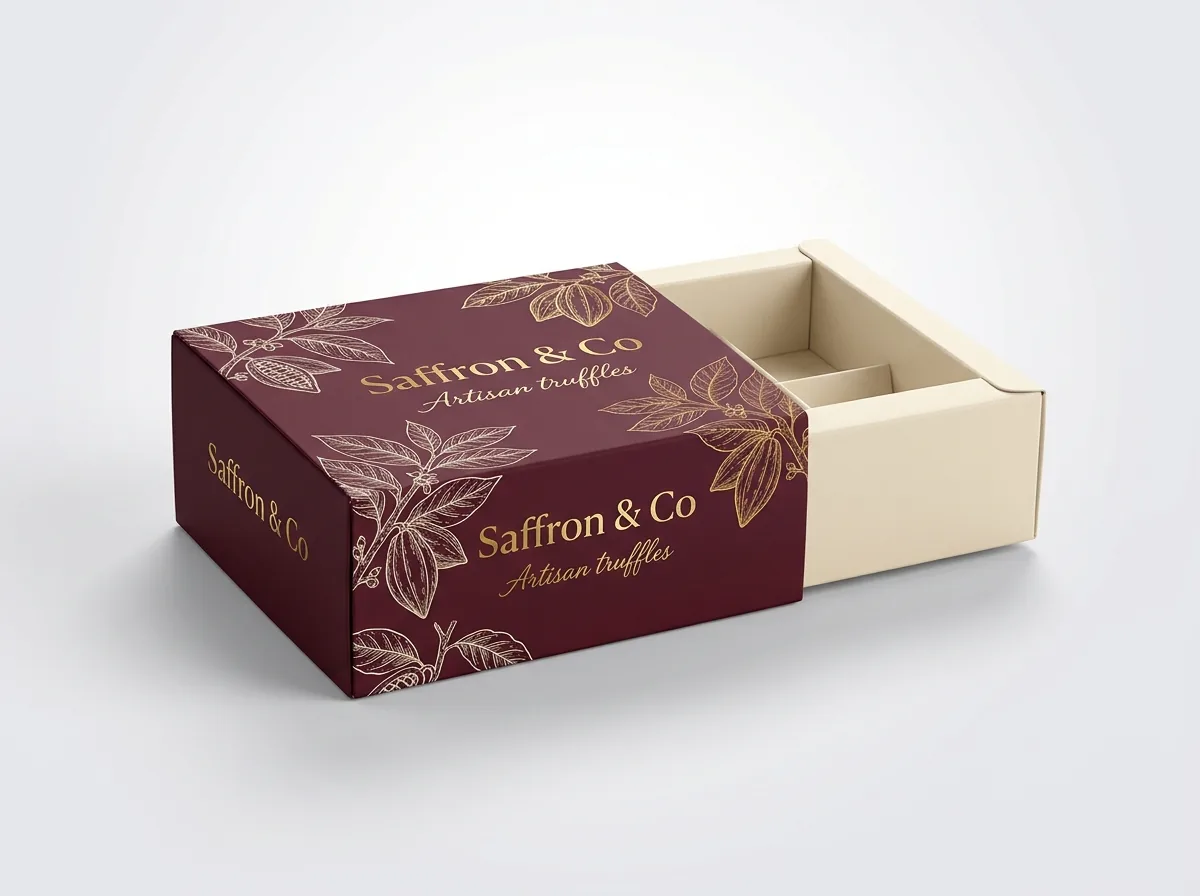



Ready to order drawer boxes with window? Compare up to 3 quantities with a free 3D mockup.
Request a Quote →Questions about drawer boxes with window
Do I quote custom window drawer boxes by inside tray size or outside sleeve size?
Always quote by the usable inside length, width, and height (L × W × H in inches) of the inner sliding drawer tray. Our structural specialists calculate board thickness, paper wrap turn-ins, and outer sleeve glide clearance automatically on your free custom dieline.
What is the minimum border width around a drawer box sleeve window?
Keep at least 0.5 inches (12.7 mm) of solid board between the window cutout edge and every sleeve fold score on compact boxes under 6 inches wide. For larger rigid gift and cosmetic drawers, use a 0.75 to 1.0 inch solid border so the top panel stays flat.
How much headspace should I add between my product and the clear window film?
Add 1/16 to 1/8 inch (1.5 to 3.0 mm) of vertical clearance between the highest point of your product and the inside top of the tray wall. That small air cushion stops frosted truffles, foil labels, or pump caps from scuffing against the clear film patch.
How much foam spacing do I need between multiple items in one window drawer?
Leave at least 0.5 inches (12.7 mm) of EVA or EPE foam around the outer tray walls and between adjacent cavities when packing glass dropper bottles, mini candles, or watches. Narrower foam walls can compress when customers lift items out of the drawer.
What is the minimum order for custom-sized window drawer boxes?
Custom rigid paper-wrapped drawer boxes with a window start at 50 units, while lighter folding paperboard tray-and-sleeve window boxes start at 1,000 units. Custom tray dimensions and custom-shaped sleeve windows carry zero die or plate charges, and every US order ships free.
Can I test my drawer glide and window alignment before ordering a full run?
Yes. Every order includes a free 2D dieline proof and an interactive 3D mockup before payment so you can inspect window framing from every angle. You can also order a paid physical prototype of your exact box or our $50 sample kit credited to your order.
Still have a question? Ask a packaging specialist.
Request a Quote →Request your drawer boxes with window quote
Tell us your size and quantities, and one dedicated account manager prepares pricing for each tier.
- Free design & AI-to-print studio + 3D mockup
- No die or plate charges · 4–5 day rush available
- Free shipping to all 50 states
- 10% off your first order
We verified sleeve-and-tray dimensional conventions, window bridge margin ratios, and film patch glue-land tolerances against Paperboard Packaging Council (PPC) structural guidelines and TAPPI board stiffness methods. A packaging specialist checked every benchmark size and clearance rule. Spot an error? Tell us and we will fix it.
Sources
- Inside-dimension quoting conventions, sleeve-to-tray sliding tolerances, and window cutout bridge stability.
- Chipboard and solid bleached sulfate (SBS) caliper deflection across die-cut window spans.
- Confirmed 50-unit rigid minimum, 1,000-unit folding minimum, 10–14 business day turnaround, zero die fees, and 3D proofing.
What changed
- November 16, 2026: First published with inner-tray vs outer-sleeve sizing formulas, 6-category benchmark table, 0.5–1.0 in window margin rules, and vertical headspace specs.
More guides
New packaging guides by email
Sizes, materials and design tips. Unsubscribe anytime.