
How do you prevent lace snags and crushed bra cups in custom lingerie boxes?
Short answer: Choose smooth clay-coated SBS board inside the carton, fold raw paper cut edges away from the garment cavity, wrap hooks and lace in acid-free tissue paper, and lay molded underwire cups open side-by-side inside custom lingerie boxes with 2.5 to 3.25 inches of vertical height.
On this page
- What causes fabric damage inside intimate apparel packaging
- How do you design a snag-free box interior for lace and silk
- How do you keep molded underwire bra cups from crushing in transit
- How do you prevent dark box ink from transferring onto ivory or pastel fabrics
- How do you balance garment protection with packing speed and cost
- Common mistakes
- FAQs
Request a custom quoteFree dieline & 3D mockup
Delicate intimate fabrics fail inside generic packaging for three mechanical reasons: raw die-cut paperboard burrs snag fine elastane and silk filaments, metal bra hooks catch on exposed lace loops when garments shift, and shallow shipping containers invert or flatten heat-molded polyurethane bra cups. Preventing damage starts with the dieline and interior surface of the box. Specifying coated white SBS paperboard or a smooth matte interior lamination eliminates rough wood-pulp fibers, while rolling the top wall edges of drawer trays outward keeps raw die-cut paper edges away from the garment cavity. Wrapping the folded piece in 17 gsm acid-free tissue paper isolates metal hook-and-eye clasps from sheer mesh and prevents dark exterior or interior inks from rubbing onto ivory bridal lace. Finally, sizing the box to 2.5–3.25 inches deep with tissue domes inside the cups keeps molded bras round from factory to bedroom.
What causes fabric damage inside intimate apparel packaging?
Eyelash lace, 15-denier sheer tulle, silk charmeuse and stretch satin contain ultra-fine yarns that pull at the slightest friction point. In a standard corrugated or unlined chipboard box, the die-cutting blade leaves a microscopic raised fiber burr along every cut edge, dust flap and locking tab slot. When a garment vibrates during parcel transit, those raw paper edges act like fine sandpaper against silk or catch a single loop of lace. At the same time, heat-molded contour bra cups lose their smooth dome shape if they are inverted or stacked under heavy parcels without internal support. Use the protection matrix below to pair each delicate lingerie material or component with the right interior engineering when ordering custom printed lingerie packaging.
| Fabric or garment feature | Primary transit risk | Box & interior fix |
|---|---|---|
| Eyelash lace & sheer tulle | Snagging on raw cut flap edges or thumb notches | Rolled-edge tray walls + full tissue envelope wrap |
| Silk charmeuse & satin slips | Micro-pulls from rough uncoated kraft fibers | Clay-coated SBS interior or matte interior lamination |
| Molded foam underwire cups | Permanent vertical dome crease from cup inversion | Open side-by-side lay in 2.5-3.25 in deep box + tissue dome |
| Metal hook-and-eye back bands | Hooks catching on front lace cups during transit | Fasten hooks closed + fold band behind a tissue layer |
| Ivory, white & blush bridal pieces | Dark interior box ink crocking in humid transit | Matte lamination over dark ink + white acid-free tissue |
| Boned corsets & longline bustiers | Warped boning channels from horizontal folding | Full-length 12-13.5 in box + flat cardstock backing board |
How do you design a snag-free box interior for lace and silk?
The safest interior wall is one with zero exposed raw paper edges facing the garment. On a standard reverse tuck end carton, the side glue lap sits inside the corner of the box, and the bottom slit-lock tabs project into the interior cavity. If an unwrapped silk camisole or lace bralette slides against that glue lap, the cut edge of the board can catch a thread. When we engineer dielines for intimate apparel, we make three structural adjustments: first, we recess and taper the interior glue lap so it bonds completely flat without a raised lip; second, on tray-and-sleeve drawer boxes and two-piece boxes, we use turned-over double side walls where the fold crease (not the raw cut edge) forms the top rim of the tray; third, on retail cartons with acetate windows, we apply the window patch adhesive cleanly back from the window cutout so no tacky glue edge ever touches the fabric during loading or customer unboxing.
- Specify coated 1-side (C1S) or coated 2-side (C2S) SBS board so the interior wall is smooth and calendered.
- Avoid metal wire stitches or staples anywhere on the carton; use full-bond food/textile-safe PVA glue seams.
- Choose a ribbon pull tab on drawer boxes rather than a die-cut half-moon thumb notch that exposes raw board.
- If using window patching, keep a minimum 6 mm glue margin outside the die-cut window opening.
How do you keep molded underwire bra cups from crushing in transit?
Even when you lay an underwire bra open side-by-side inside a 9.5 × 6.5 × 2.5 inch box, parcel sorting conveyors can stack heavier packages on top of the shipment. To keep molded foam domes from flattening under top load, support the cup from both the outside and the inside. On the outside, choose a box structure with high vertical sidewall compression strength: either an E-flute corrugated custom mailer box for direct shipping, or a double-wall tray-and-sleeve drawer box for retail. On the inside, place a lightweight dome of crumpled acid-free tissue paper (or a thin thermoformed or molded-pulp cup insert for high-volume lines) underneath each bra cup cavity. That internal pillow supports the center crown of the foam cup so it rebounds immediately when unpacked. Also check that the underwire tips do not press directly against the left and right walls of the carton; leaving a 0.25 inch buffer on each side prevents side impacts from bending the underwire channel or poking the wire tip through the casing fabric.
Know your size? Compare pricing across up to 3 quantities.
Request a Quote →How do you prevent dark box ink from transferring onto ivory or pastel fabrics?
Many intimate apparel brands love dramatic, moody interior palettes: deep espresso, midnight black, plum or oxblood burgundy printed across the inside of the box. However, unvarnished dark offset ink sitting directly against white bridal lace, champagne silk or pastel modal can experience 'crocking' (dry or wet ink rub) when a package sits in a warm, humid delivery van. To eliminate ink transfer risk, always seal dark interior printing under a matte, gloss or soft-touch lamination film, or an anti-rub aqueous coating. Then line the box with custom tissue paper and seal it with a custom seal sticker. Use unprinted white or light pastel acid-free (pH-neutral, lignin-free) tissue paper as the inner layer that touches white or ivory garments so the fabric stays bright even during long warehouse storage. If you want a dark branded tissue sheet for the unboxing look, use a two-sheet wrap: place a plain white acid-free sheet directly around the white lace garment, and wrap your dark logo-printed sheet around the outside.
- Seal dark interior Pantone or CMYK floods with matte or soft-touch film lamination so pigment is locked in.
- Wrap white, ivory and blush garments in unprinted white acid-free tissue paper inside dark boxes.
- Fasten all metal hook-and-eye closures before folding, and tuck the metal clasp under a fold of tissue paper.
- For metallic straps or rhinestone sliders, fold a tissue sheet between the hardware and the front lace cup.
How do you balance garment protection with packing speed and cost?
Adding protective touches does not have to slow down your fulfillment team or inflate your unit cost. A single sheet of custom tissue paper folded envelope-style around a bra set takes about eight seconds on the packing bench and solves three problems at once: it separates metal hooks from lace, shields light fabrics from dark box walls, and creates a boutique reveal when secured with a branded sticker. If you want to cut hand-folding time on high-volume panty and bralette runs, pair a pop-up two-piece box or auto-bottom carton with a pre-cut smooth card folding board. Operators simply fold the bralette around the rounded-corner card and drop it into the carton in one motion, keeping every retail package uniform on the shelf. Your first order at CubitPack includes 10% off, free structural dielines, no die or plate charges, and a free digital proof and 3D mockup before payment.
What are the most common lingerie packing and prepress mistakes?
Avoid these five interior packaging oversights and prepress errors before approving your custom lingerie box production run so delicate lace, sheer tulle and silk garments arrive completely snag-free
- Leaving bra back bands unhooked inside the box so exposed metal hooks catch on sheer mesh and eyelash lace during transit.
- Printing unlaminated heavy black or burgundy ink on the inside of a box that holds unwrapped white or ivory bridal lingerie.
- Forgetting to tuck a small pillow of tissue paper underneath molded contour bra cups to support the foam crown.
- Using rough unlined chipboard or stapled cartons with exposed interior burrs that pull delicate silk charmeuse threads.
- Applying window-patch film with excess glue squeeze-out around the cutout edge where fine fabrics can stick.
Find your size
Suggested inside size: 5.5 × 4.0 × 1.0 in
A starting point. Your account manager confirms the size with you before the proof.
Quote this size →Packaging for this
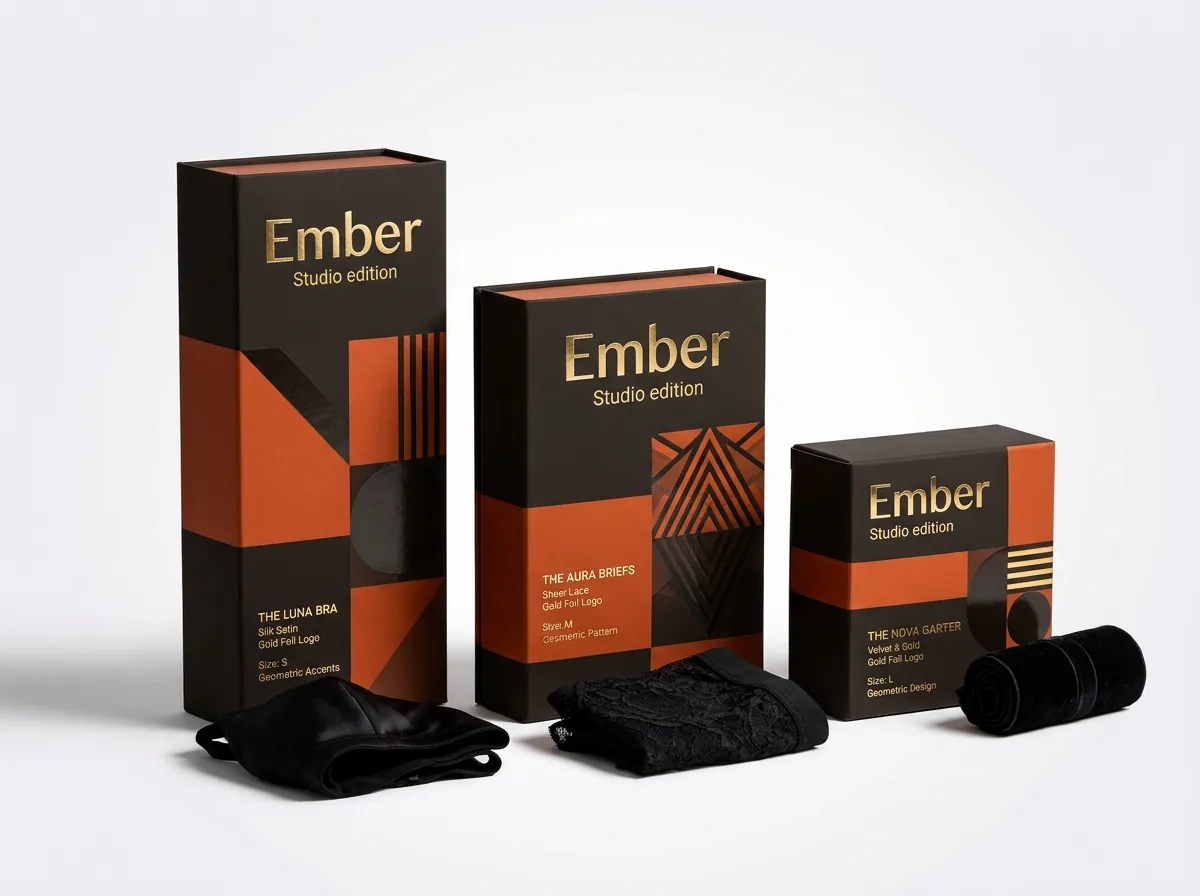
Ready to order lingerie boxes? Compare up to 3 quantities with a free 3D mockup.
Request a Quote →Questions about lingerie boxes
Why should tissue paper for silk and bridal lingerie be acid-free?
Standard wood-pulp paper contains natural acids and lignin that gradually yellow over time and can transfer a faint ivory cast onto pure white silk or nylon lace during months of warehouse storage. Acid-free, lignin-free tissue paper stays pH-neutral.
Does soft-touch or matte lamination inside the box stop ink rub?
Yes. Laminating a thin matte or soft-touch film over dark interior printing seals the pigment underneath a smooth polymer layer, preventing dry or humid ink crocking onto light-colored fabrics and making the interior walls completely snag-free.
How do we keep a molded bra cup round without ordering expensive plastic forms?
Lay the bra open side-by-side in a 2.5 to 3.25 inch deep box and tuck a small ball of acid-free tissue paper into each cup hollow before folding the outer tissue sheet over the top. It costs pennies and recycles with paper.
Are window boxes safe for delicate lace panties and bralettes?
Yes, as long as the garment is folded around an inner card insert or wrapped in tissue so the lace does not catch on the inside edge of the window cutout. We also keep window adhesive recessed from the opening.
Can we order custom printed tissue paper and seal stickers in the same quote?
Yes. CubitPack produces custom logo tissue paper, foil seal stickers and garment care insert cards alongside your lingerie boxes so your Pantone colors match across the outer box and inner wrap.
Can I test a physical sample of our lingerie box with our actual garments?
Yes. Every order includes a free digital proof and 3D mockup before payment, and you can also order a paid printed structural sample of your exact box (credited toward your production order) to test with your lace and silk.
Still have a question? Ask a packaging specialist.
Request a Quote →Request your lingerie boxes quote
Tell us your size and quantities, and one dedicated account manager prepares pricing for each tier.
- Free design & AI-to-print studio + 3D mockup
- No die or plate charges · 4–5 day rush available
- Free shipping to all 50 states
- 10% off your first order
The interior finishing, tissue wrapping and cup-support practices in this guide are based on TAPPI ink rub resistance standards, ISTA parcel compression guidelines and intimate apparel QC checklists. A CubitPack packaging specialist reviewed every step. Spot an error? Tell us and we will fix it.
Sources
What changed
- October 22, 2026: First published.
- October 22, 2026: Updated specifications, terminology, and verified source links.
More guides
New packaging guides by email
Sizes, materials and design tips. Unsubscribe anytime.