
How do I design custom hot sauce boxes and bottle inserts that survive shipping?
Short answer: Design custom sauce boxes that survive shipping by locking both ends of each glass bottle (a bottom cell partition plus a top neck collar), keeping front window cutouts at least 5/8 inch inside corner scores, and adding matte or gloss lamination to resist vinegar and oil.
On this page
- Why do glass woozy bottles need dual-point retention in 3-pack and 4-pack boxes
- How do I align front window cutouts with my bottle label and keep the carton rigid
- Which finishes and Scoville heat-scale layouts make sauce cartons stand out
- What FDA labeling rules apply to retail hot sauce and BBQ sauce cartons
- How do I lower unit cost across multiple sauce flavors and gift sets
- Common mistakes
- FAQs
Request a custom quoteFree dieline & 3D mockup
Great hot sauce packaging has to solve a structural problem and a storytelling problem at the same time. Structurally, a filled 5 oz glass woozy bottle or 12 oz BBQ flask is a dense, narrow pendulum: if you only separate the bottom bases in a 3-pack or 4-pack gift set, a sideways parcel drop whips the narrow bottle necks together and snaps the glass at the shoulder. Dual-point immobilization - combining a full-height E-flute divider or cradle with a die-cut top neck retainer collar - stops both base clinking and neck whiplash. Visually, aligning front window cutouts with your bottle's wrap-around label, printing a color-coded Scoville heat scale across SKU flavors, and protecting the carton with wipe-clean lamination turns every bottle or gift flight into a retail magnet. CubitPack provides free dielines, digital proofs, and 3D mockups on every order from 1,000 boxes.
Why do glass woozy bottles need dual-point retention in 3-pack and 4-pack boxes?
A standard 5 fl oz (148 ml) glass woozy bottle has a 1.75 inch base diameter that tapers sharply at the shoulder into a narrow 1.0 inch neck. When three or four woozy bottles stand upright in a gift box with only a shallow bottom divider tray, the upper half of each bottle floats in open air. If a courier drops the carton onto its side, the heavy caps act like levers and slam the glass shoulders into one another. To pass parcel drop tests on printed hot sauce boxes, engineer dual-point retention. First, use a folded paperboard or E-flute corrugated cell partition that rises at least up to the bottle shoulder so glass bases never touch. Second, fold a die-cut top neck collar (with 1.1875 inch circular holes spaced to match the cells below) down over the screw caps before closing the top lid. For horizontal 4-bottle or 6-bottle challenge mailers, use a die-cut E-flute cradle with recessed finger notches and a 3/8 inch perimeter air buffer on all four sides.
- Base isolation: place a full-depth E-flute corrugated wall between every adjacent glass bottle.
- Neck immobilization: add a die-cut top collar that grips the 24-414 neck finish right below the cap.
- Perimeter air gap: leave a 3/8 inch double-wall buffer around horizontal mailer cradles to absorb corner drops.
- Pre-glued base: always pair upright multi-bottle dividers with an auto-lock bottom so the floor cannot sag.
How do I align front window cutouts with my bottle label and keep the carton rigid?
On upright single-bottle cartons and 3-bottle gift trios, an open front cutout lets shoppers read your bottle's flavor name and see the actual sauce color without opening the box. Two structural rules govern front bottle cutouts: vertical registration with your bottle label, and corner-score margin strength. A standard 5 oz woozy bottle has a straight label panel roughly 3.5 to 3.75 inches tall, starting about 0.375 inch above the bottom heel and ending at the shoulder curve. Position the bottom edge of your carton's die-cut window 0.625 inch above the box floor and stop the top edge at 4.0 inches high so the cutout frames only the flat label and never exposes the empty air space around the narrow bottle neck. Just as important, keep the left and right edges of any cutout at least 3/8 to 1/2 inch away from the vertical corner fold scores on custom window boxes so the front pillars do not buckle when boxes are stacked. Rounding the four corners of your rectangular cutout with a 1/8 inch radius also prevents the paperboard from tearing when customers slide bottles in and out.

Which finishes and Scoville heat-scale layouts make sauce cartons stand out?
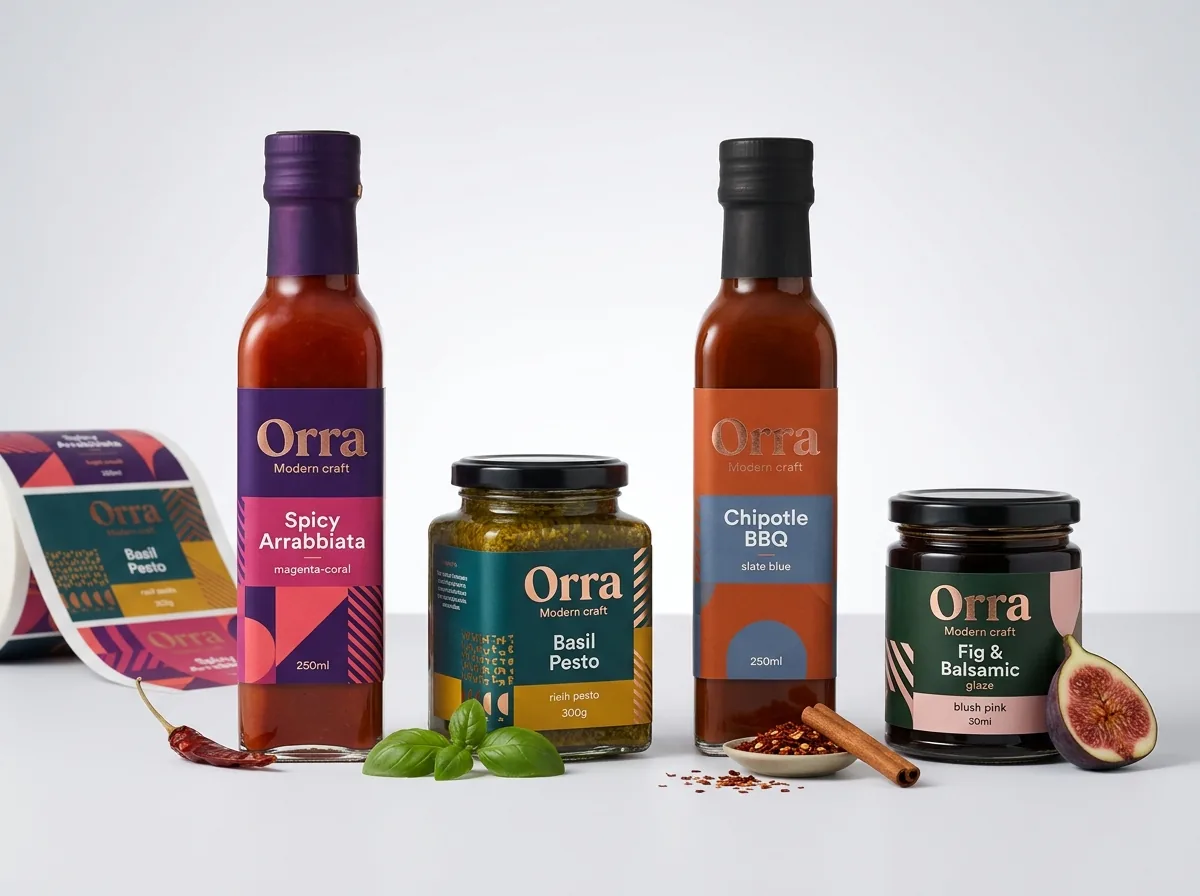
Hot sauce buyers shop by heat level and flavor profile simultaneously. Standardizing one carton dieline across your entire 5 oz lineup lets you build a cohesive brand block on grocery shelves while using color bands and tactile finishes to signal Scoville heat units (SHU) in a split second. Many craft sauce makers place a vertical thermometer bar or five-chili rating meter along the left edge of the front face and repeat the heat level on the top tuck flap so bottles stored in kitchen drawers or counter display trays are identifiable from above. Beyond shelf aesthetics, sauce cartons face messy real-world conditions: humid summer farmers markets, cold refrigerator doors, and tasting-table splashes of vinegar, garlic, and chili oil. Applying an exterior film lamination seals the paperboard fibers so condensation and sauce drips wipe right off. Use the table below to match your sauce style with the right board stock, protective lamination, and tactile embellishment.
| Design element | Recommended spec | Why it works for sauces |
|---|---|---|
| Exterior lamination | Matte, gloss, or soft-touch film | Seals board against vinegar drips, chili oil, and fridge moisture |
| Heat-scale callout | Spot UV chili meter on matte black/white | High-gloss flame bars pop against a non-glare background |
| Reserve / truffle editions | Gold, red, or copper foil stamping | Metallic accents elevate holiday gift trios and aged pepper reserves |
| Smokehouse & fermented lines | Unbleached brown kraft + white ink underbase | Opaque white ink keeps pepper graphics bright on earthy kraft |
| Tasting flight unboxing | Full-color inside-lid printing | Turns the open mailer lid into a Scoville chart and wing pairing guide |
Know your size? Compare pricing across up to 3 quantities.
Request a Quote →What FDA labeling rules apply to retail hot sauce and BBQ sauce cartons?
When an enclosed carton or gift box surrounds your sauce bottles at retail, federal labeling rules require the outer carton to display all mandatory consumer disclosures (unless an open window leaves the entire required statement on the bottle unobstructed). Under FDA 21 CFR 101, the bottom 30 percent of the principal display panel must state the net quantity of contents in both US fluid ounces and metric milliliters - for example, NET 5 FL OZ (148 mL) for a single bottle or 3 BOTTLES · 5 FL OZ (148 mL) EACH · NET 15 FL OZ (444 mL) on a 3-pack trio. The information panel (typically the right side panel or back panel) must list the Nutrition Facts table, ingredients in descending order of weight, manufacturer or distributor name and street address, and any major food allergens such as soy, wheat, sesame, or fish (common in Worcestershire, teriyaki, barbecue glazes, and Asian chili sauces). If your sauce is an acidified food or requires refrigeration after opening, place a bold REFRIGERATE AFTER OPENING badge and SHAKE WELL prompt near the nutrition panel and match it on your custom sauce labels.

How do I lower unit cost across multiple sauce flavors and gift sets?
Because all 5 oz woozy bottles share the exact same outside geometry, you never need separate dielines for different flavors. Ordering 1,000 or 2,500 boxes split across Mild Jalapeno, Roasted Habanero, Mango Scotch Bonnet, and Smoky Chipotle on one shared auto lock bottom carton dieline lets you combine volume in a single multi-version production run. Similarly, if you sell a 3-bottle holiday gift box alongside a year-round tasting trio, print the outer window carton with evergreen branding and use your bottle labels visible through the front cutouts to show which three flavors are packed inside. That way one box run serves summer grilling packs, autumn tailgate sets, and holiday gift orders without leftover seasonal inventory.
What are the most common hot sauce box and insert design mistakes?
Skipping neck retention or misaligning window cutouts can ruin a sauce launch. Check these five design traps before approving your proof
- Designing a 3-pack or 4-pack upright hot sauce box with a bottom divider only and no top neck collar to stop bottle necks from snapping.
- Extending a front window cutout above the bottle shoulder, exposing empty space around the narrow glass neck instead of framing the label.
- Cutting front windows closer than 3/8 inch to vertical fold scores, weakening the corner columns of tall narrow cartons.
- Forgetting dual metric and US fluid-ounce net quantity statements (e.g., 5 FL OZ / 148 mL) on the lower 30% of the front panel.
- Printing dark chili-red or black ink on unlaminated board that scuffs during parcel vibration and stains from tasting splashes.
Find your size
Suggested inside size: 1.875 × 1.875 × 6.875 in
A starting point. Your account manager confirms the size with you before the proof.
Quote this size →Packaging for this

Ready to order sauce boxes? Compare up to 3 quantities with a free 3D mockup.
Request a Quote →Questions about sauce boxes
How do you stop glass hot sauce bottles from breaking in the mail?
Use dual-point bottle immobilization inside an E-flute corrugated mailer or shipper. A bottom partition or die-cut cradle separates the heavy glass bases, while a top neck collar or recessed neck slot stops the narrow necks from whipping on impact.
How tall should the front window cutout be on a 5 oz woozy bottle carton?
Keep the window cutout roughly 3.25 to 3.375 inches tall, starting 5/8 inch above the bottom crease and stopping just below the bottle shoulder at 4.0 inches high so it frames only your wrap-around bottle label.
Which finish prevents hot sauce drips or condensation from staining the carton?
Matte, gloss, or soft-touch film lamination seals the paperboard surface so accidental vinegar splashes, chili oil, or cold refrigerator condensation wipe off cleanly without soaking into the ink or board fibers.
Can I print a Scoville heat chart inside the lid of a 3-bottle or 4-bottle box?
Yes. Inside printing is available on both folding cartons and corrugated mailers. Printing a Scoville heat scale, tasting order, and food pairings inside the lid creates an interactive unboxing experience.
Do I need food-safe board if my hot sauce is sealed in a glass bottle?
When liquid sauce is sealed inside a capped glass bottle, standard white card, kraft, or E-flute corrugated board works well. If single-serve dipping packets or dry sauce mixes touch the board directly, request food-safe materials on your quote.
Will your designers build both the outer sauce box and the bottle divider dieline?
Yes. Every CubitPack order includes free structural dielines for both the outer carton and any internal partition, neck collar, or bottle cradle, plus a free digital proof and 3D mockup before payment.
Still have a question? Ask a packaging specialist.
Request a Quote →Request your sauce boxes quote
Tell us your size and quantities, and one dedicated account manager prepares pricing for each tier.
- Free design & AI-to-print studio + 3D mockup
- No die or plate charges · 4–5 day rush available
- Free shipping to all 50 states
- 10% off your first order
This guide combines ISTA 3A glass bottle drop-protection principles, standard 5 oz (148 ml) woozy bottle geometry, and FDA 21 CFR 101 liquid labeling rules. A CubitPack packaging specialist verified every section. Spot something off? Tell us and we will fix it.
Sources
What changed
- October 22, 2026: First published.
- October 22, 2026: Updated specifications, terminology, and verified source links.
More guides
New packaging guides by email
Sizes, materials and design tips. Unsubscribe anytime.