
How do I design custom baby clothes boxes for baby shower gifting without plastic pins?
Short answer: Replace sharp plastic tagging barbs with a die-cut paperboard divider tray and garment backing card, add an arch or cloud feeler window so shoppers can touch the cotton, and print a 'To / From' gift plate inside the lid. Explore structures on our custom baby clothes boxes page.
On this page
- How do paperboard inserts replace plastic barbs and pins in baby layette sets
- What should go on each panel of a custom baby clothes box
- Should I design an open feeler window or a clear film window
- How do I turn the inside lid into a built-in baby shower greeting card
- How do I keep custom printing costs low across multiple colors and sizes
- Common mistakes
- FAQs
Request a custom quoteFree dieline & 3D mockup
Over half of boutique newborn clothing is purchased as a gift for baby showers, hospital visits and first birthdays, which means your carton has to work simultaneously as a retail display, a protective garment holder and a finished gift wrap. The smartest design upgrade you can make is eliminating plastic tagging barbs and metal pins entirely. Instead, use a die-cut paperboard backing card or multi-cavity insert tray that holds a folded bodysuit, knit booties, a cap and a bib neatly in view behind your front window. Pair that pin-free interior with soft-touch or matte lamination, clear age-stage badges (such as Newborn, 0-3M and 3-6M) on both the front panel and top flap, and an inside-lid 'Welcome Little One' dedication plate. At CubitPack, custom window shapes, divider dielines, design help and 50-state shipping are all included free.
How do paperboard inserts replace plastic barbs and pins in baby layette sets?
Ask any new parent what frustrates them most when opening a baby shower clothing set, and they will mention snipping a dozen tiny plastic tagging barbs out of a newborn bodysuit and worrying a hidden plastic T-end fell into the knit. Beyond irritating parents, plastic fasteners can pull threads in delicate organic cotton pointelle, bamboo jersey and fine merino knitwear. When we engineer gift-ready custom baby clothes boxes, we replace plastic fasteners with folded paperboard mechanics. For a single onesie or sleeper, a flat paperboard backing card with two side-lock notches holds the garment taut behind the front window and keeps a paper belly band centered. For 3-piece to 5-piece layette sets, a die-cut paperboard divider tray creates dedicated recessed cells for a folded romper, rolled booties, scratch mittens and a knotted hat so every item stays framed in place without a single plastic pin.
- Notched garment backing card: keeps a single bodysuit or romper upright and flat behind a vertical window.
- Paperboard belly band slot: wraps around rolled muslin swaddles or 3-pack onesies using a simple tab lock.
- Multi-cavity layette tray: separates a main garment from booties, bibs, bonnets and wooden teethers.
- Die-cut neck-tab retainer: holds a tiny hanger-style presentation inside a two-piece box using folded card alone.
What should go on each panel of a custom baby clothes box?
A baby clothes carton has six outer surfaces plus the interior lid and divider tray. Because gift shoppers scan for age range, fabric softness and gift readiness in seconds, assigning each piece of information to the right panel keeps your front face clean and storybook-pretty. Use the panel-by-panel layout table below when briefing your illustrator or working with our free design team. Notice how the age badge appears on two different panels so shoppers can find their size whether the box is standing face-out on a wall or stacked flat on a boutique table.
| Carton panel or zone | What to place here | Structural & prepress tip |
|---|---|---|
| Front display panel | Brand wordmark, die-cut window, fabric callout (e.g., 100% Organic Cotton) & age badge | Keep at least ¾ in of board margin around the window cutout |
| Top end flap or lid rim | Duplicate age badge (NB, 0-3M, 3-6M, 6-12M) for stacked table browsing | Use high-contrast type or a color-coded pastel band per age tier |
| Inside top lid | Printed 'Welcome Little One - To / From' gift note plate & nursery pattern | Leave the writing box unlaminated so ballpoint pen ink does not smear |
| Back panel | Garment care symbols, gentle wash instructions, brand story & size chart | Include height/weight ranges in inches and pounds beside the month size |
| Bottom tuck flap | UPC barcode, SKU code, fiber content & country-of-origin text | Print barcode in solid black on a white or pale unvarnished box |
Should I design an open feeler window or a clear film window?
Texture sells infant clothing. When a shopper picks up a bamboo viscose sleeper or a brushed organic cotton bodysuit, feeling the fabric between their fingers often closes the sale. Because CubitPack never charges cutting die fees, you can shape your front window into a soft arch, a cloud, a rounded rectangle or a storybook silhouette at no extra tooling cost. Choose an open, film-free feeler cutout (around 2.5 × 2.5 inches or 3 × 4 inches) when your garments are sold in clean boutique environments and have a signature ribbed, waffle or brushed texture. Choose a clear film-patched window when packing bright white christening outfits, pale ivory layettes or multi-piece sets that include small accessories like booties, ensuring store dust and handling never mark the fabric. To frame the window cleanly, keep at least ¾ inch of solid paperboard between the die-cut edge and any outer fold crease. Pair the exterior board with matte or soft-touch lamination so the carton feels as gentle in the shopper's hand as the baby knit inside.
- Open feeler cutout (no film): best for bamboo jersey, waffle knits and ribbed organic cotton in boutiques.
- Clear film window patch: best for white christening wear, pale cream layettes and multi-compartment gift boxes.
- Custom window shapes: arches, clouds, stars and rounded frames included with zero cutting die fee.
- Safe frame margin: leave ¾ inch (0.75 in) from any window cutout to the nearest fold score line.
Know your size? Compare pricing across up to 3 quantities.
Request a Quote →How do I turn the inside lid into a built-in baby shower greeting card?
When someone buys a baby gift box, they almost always have to buy a separate greeting card and gift bag. You can save your customers that step and make your brand unforgettable at the baby shower by printing the inside of your box. On custom two-piece boxes, custom mailer boxes and hinged custom magnetic closure boxes, ask our prepress team to flood the interior walls with a soft botanical or starry illustration and frame a cream rectangle in the center of the inside lid reading 'Welcome Little One - With love from: ____'. We leave a knock-out zone free of slick lamination over the writing lines so a shopper can sign the lid with any regular pen. You can also add a QR code on the bottom interior flap that links parents to gentle washing instructions or your newborn size-up registry discount, turning a one-time baby shower gift into a repeat customer when the baby outgrows 0-3M.
How do I keep custom printing costs low across multiple colors and sizes?
A typical infant collection launches in four or five age ranges and three or four gender-neutral or pastel colorways. Ordering fifteen separate box sizes and artwork setups would fragment your quantities. Instead, design one master neutral box, such as warm unbleached kraft board printed with crisp white ink, or soft cream white card with matte lamination and a champagne gold foil logo. Let the garment fabric showing through the front die-cut window provide the colorway, and handle the age range either by printing a neat five-box size checklist on the back panel or applying a coordinated custom seal sticker over the top flap for NB, 0-3M, 3-6M, 6-12M and 12-18M. You get the volume pricing of a single unified box run, 10% off your first order, and guaranteed Pantone color matching.
- Fold NB through 18M bodysuits around one shared backing card so every age tier uses the same box size.
- Let the die-cut front window reveal the garment color instead of printing separate boxes per colorway.
- Use a top-flap age sticker or printed back-panel size row to identify Newborn, 0-3M, 3-6M, 6-12M and 12-18M.
- Request a quote with three quantity tiers (such as 1,000, 2,500 and 5,000 boxes) to compare volume savings.
What are the most common baby clothes box design mistakes?
A few small prepress oversights can make a baby gift box harder to shop on a shelf or harder for parents to open. Check these five before approving your digital proof
- Using plastic tagging barbs to hold booties and hats instead of a die-cut paperboard divider tray.
- Applying slick gloss lamination over an inside-lid 'To / From' gift note box where ballpoint pen ink will smudge.
- Printing pale pastel yellow or white text on a cream background without enough contrast for grandparents to read the age size.
- Printing the retail price directly on the carton artwork where a baby shower buyer cannot remove it before gifting.
- Placing a die-cut window closer than ¾ inch to a fold score, which weakens the front panel frame.
Find your size
Suggested inside size: 6 × 6 × 1.5 in
A starting point. Your account manager confirms the size with you before the proof.
Quote this size →Packaging for this
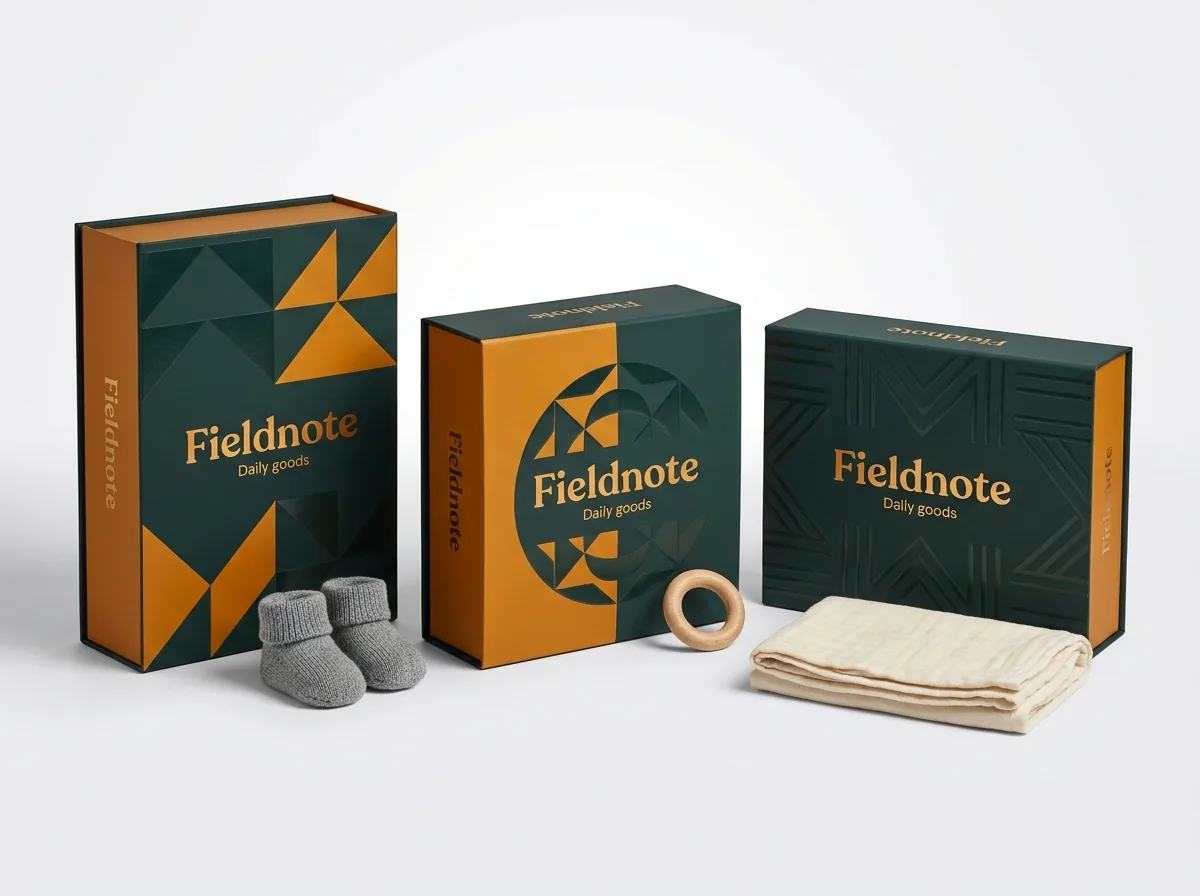

Ready to order baby clothes boxes? Compare up to 3 quantities with a free 3D mockup.
Request a Quote →Questions about baby clothes boxes
Do you charge extra for custom window shapes like clouds, arches or hearts?
No. CubitPack never charges die or plate fees on any custom baby clothes box. Whether you want a soft arch window, a cloud cutout, a built-in hanger tab or a custom multi-cavity layette insert tray, the tooling is included free.
How do you guarantee my pastel nursery Pantone colors print accurately?
Pale sage, dusty rose, butter yellow and powder blue can shift easily in standard four-color CMYK printing. When you specify Pantone (PMS) spot codes, CubitPack guarantees an accurate Pantone match: if a printed Pantone shade is clearly off from the approved spec, we reprint free.
Can I print white ink on unbleached brown kraft baby clothes boxes?
Yes. Opaque white ink on natural brown kraft board is a signature look for organic cotton and gender-neutral babywear brands. We can print a crisp white ink botanical frame around your window or use white ink as an underbase beneath pastel colors.
What if I do not have a graphic designer or vector dieline yet?
Every CubitPack order includes free design help and a free custom vector dieline. Send us your logo, nursery sketch or even an AI-generated concept image, and our designers will lay out your box, age badges and divider insert and build a free 3D mockup.
Are textile fiber content and origin required on the outside of a closed baby box?
Under US textile labeling rules, if an infant garment is sold in a sealed retail package that shoppers cannot open before buying, the fiber composition and country of origin should be visible either through the window on the garment tag or printed on the outside carton.
Can I see a digital proof and 3D mockup before paying for my order?
Yes. You always receive a flat 2D digital proof and an interactive 3D mockup showing your window cutout, inside printing and foil or emboss placement before you pay a cent. Production takes 10 to 14 business days after approval, with 4 to 5 day rush available.
Still have a question? Ask a packaging specialist.
Request a Quote →Request your baby clothes boxes quote
Tell us your size and quantities, and one dedicated account manager prepares pricing for each tier.
- Free design & AI-to-print studio + 3D mockup
- No die or plate charges · 4–5 day rush available
- Free shipping to all 50 states
- 10% off your first order
The structural and prepress recommendations in this guide draw from CubitPack's decided rules in our published product specifications, children's product presentation practices and US textile labeling guidelines. A CubitPack packaging specialist checked every section. Spot something wrong? Tell us and we will fix it.
Sources
What changed
- October 22, 2026: First published.
- October 22, 2026: Updated specifications, terminology, and verified source links.
More guides
New packaging guides by email
Sizes, materials and design tips. Unsubscribe anytime.